Summary
Editor's rating
Value for money: decent deal if you already own Makita batteries
Design: practical ideas with a bit of cheap feel
Battery usage: Makita compatible, but nothing included
Build quality and durability after a few jobs
Performance on real tiles: strong vibration, a few limits
What this tile vibrator actually offers on paper
Pros
- Strong vibration with 9 adjustable speeds suitable for tiles from about 30 cm up to large panels
- Compatible with Makita 18 V batteries, handy if you already own BL18xx packs
- Suction cup holds well on clean, smooth to lightly textured tiles and really helps with positioning
Cons
- No battery or charger included, makes it less interesting if you don’t already use Makita
- Heavier and less refined than pro brands; tiring on walls and at high speed
- Suction cup durability on very rough or abrasive tiles is a bit uncertain for intensive daily use

Specifications
View full product page →| Brand | DENEWERK |
A cheap way to save your back on big tiles
I used this 2‑in‑1 tile vibrator with suction cup on a small renovation job: about 25 m² of large-format porcelain tiles (60×120 cm) and a few wall tiles in a bathroom. I already own a branded tile vibrator from Rubi, so I had a pretty clear idea of what I was looking for and where cheap tools usually cut corners. I grabbed this one mainly because it was compatible with my Makita 18 V batteries and the price was lower than the big brands.
From the first day, my goal was simple: see if it really helps to de‑air the adhesive and handle big tiles, or if it’s just another gadget that will end up in the back of the van. I pushed it a bit: rougher outdoor tiles, smoother bathroom tiles, and a couple of wood‑effect planks. I also tried it both on the floor and on a vertical wall to see how the suction behaved.
Overall, it does the job: it vibrates strongly, the suction cup holds pretty well when you respect the size and surface, and the fact that it takes Makita batteries is a big plus if you’re already in that ecosystem. But it’s not perfect. There are some details where you feel it’s a cheaper tool: the plastics, the balance in the hand, and the noise at high speed. Nothing shocking, but you feel it’s not a premium pro tool.
If you’re expecting a magic solution that will make you lay tiles twice as fast, you’ll be disappointed. If you just want a reasonably priced vibrator to help you place and adjust medium to large tiles without destroying your wrists, it’s pretty solid for the price. Just keep in mind the limitations, especially on very rough or very small tiles.
Value for money: decent deal if you already own Makita batteries
On value for money, I see this tool as a good compromise if you’re already equipped with Makita 18 V batteries. The price is clearly lower than big brands like Rubi or Raimondi, while still offering enough power and features for real work. You get strong vibration, Makita compatibility, a big suction cup, and a spirit level. For a small business or a serious DIYer, that’s already quite a lot for the cost.
The catch is really the battery situation. For anyone without Makita gear, you have to factor in at least one or two batteries plus a charger, and then the total price starts to approach that of more established brands that sometimes include their own battery in a kit. In that case, the value becomes less obvious, and I’d seriously compare with full kits from other manufacturers before deciding.
Compared to my more expensive vibrator, this one feels a bit less refined and a bit heavier, but in terms of tile results (adhesive de‑airing, ease of adjustment), the difference isn’t huge. So if budget is tight and you’re fine with a slightly rougher finish and maybe a shorter lifespan on the suction cup, this product makes sense. You’re not paying for a big name, you’re paying for a tool that gets the job done without too many extras.
In short, I’d say the value is pretty solid for Makita users who want a dedicated tile vibrator without spending too much. For everyone else, the lack of included battery and the unknown brand reduce the attractiveness a bit. It’s not a scam, it’s just a straightforward tool: decent performance, some compromises, and a price that reflects that.
Design: practical ideas with a bit of cheap feel
The overall design is quite straightforward: a chunky body, a rectangular suction cup at the bottom, and a plastic handle on top. You can tell they tried to make it ergonomic, but it still feels a bit bulky compared to more compact pro models. At 2.63 kg, once you add a Makita 5.0 Ah battery, it becomes noticeably heavier. On the floor it’s fine, but when you hold it on a wall for a while, you really start to feel it in the forearm and shoulder.
The handle is plastic with a built‑in damping spring. In practice, the spring takes off a bit of the harshest vibrations, but don’t expect miracles: at higher gears, your hand still buzzes a lot. Grip is decent, even with slightly dusty gloves, but the plastic itself feels a bit cheap. Not fragile right away, just not the same as a premium brand. The non‑slip texture helps, though; I never had the impression it would slip from my hand.
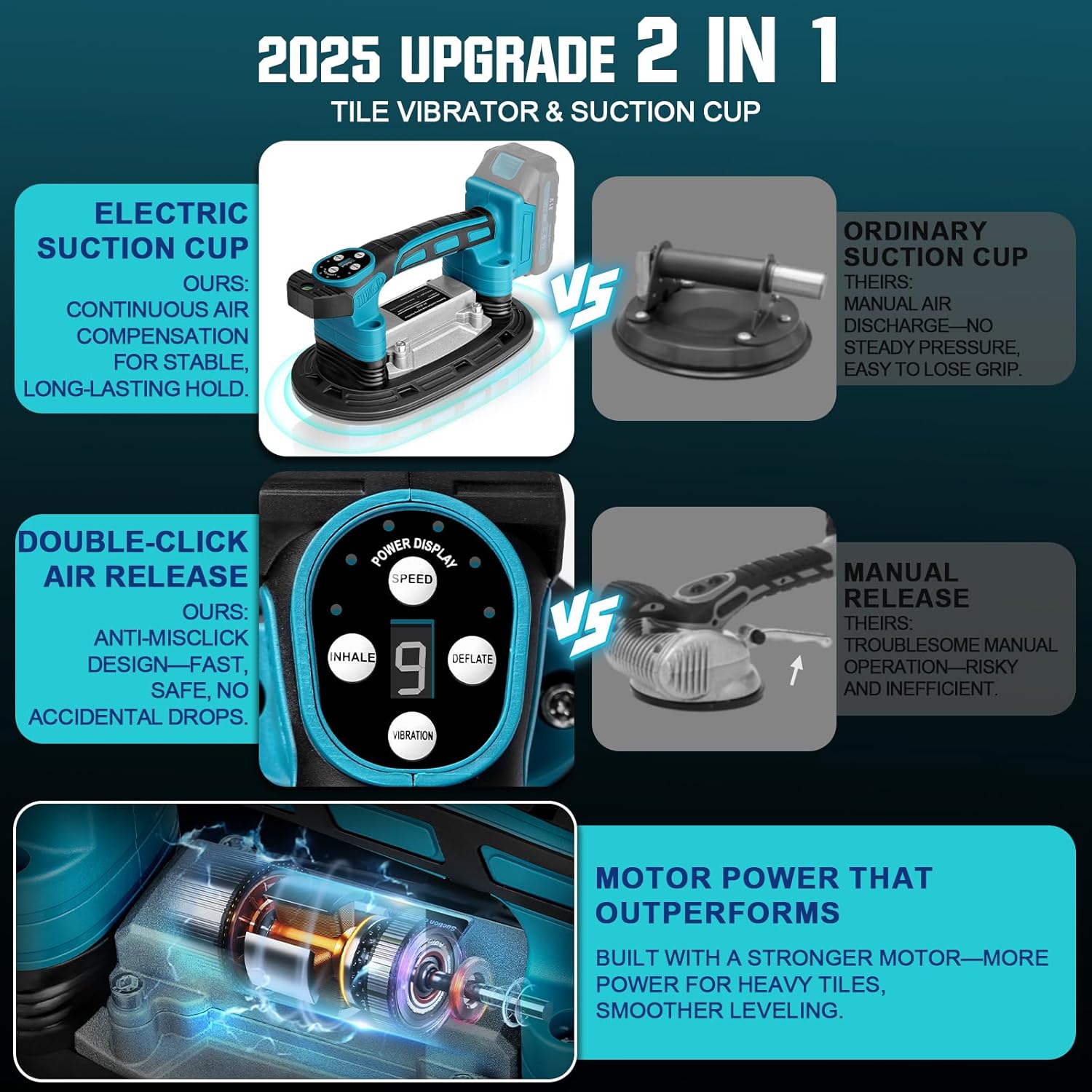
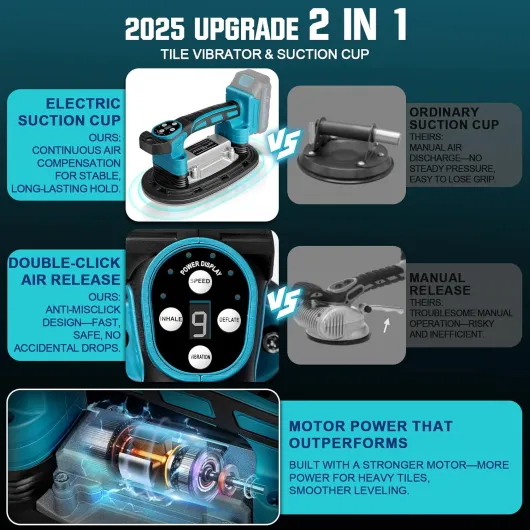
I liked the double‑click vent button idea. You have to double‑click to release the suction, which limits accidental releases when you’re moving a tile. It’s a small safety that makes sense. The integrated spirit level is also handy: I actually used it a few times to do quick checks on horizontal alignment without grabbing a separate level. It’s not as accurate as a proper level, but for quick corrections it’s good enough.
On the downside, the balance of the tool isn’t perfect. With the battery attached, the weight is mainly at the back, and when you’re placing it on a vertical tile, you sometimes have to fight a bit to keep it flat before full suction kicks in. The controls are also quite basic: one button for speed, one for suction. It works, but there’s no clear indicator of which gear you’re on except by feel and sound. For the price, the design is functional and gets the job done, but you do feel some compromises in comfort and finish.
Battery usage: Makita compatible, but nothing included
The big selling point here is that the tool is compatible with Makita 18 V batteries. I used it mainly with BL1850 (5.0 Ah) packs that I already own for my drills and saws. The fit on the battery slide is correct: it clips in firmly, no wobble, and the contacts seem properly aligned. I didn’t have any random cutouts or bad connections, which is something I always watch for on non‑Makita tools that claim compatibility.
In terms of battery life, with a 5.0 Ah pack, I managed roughly one long working session of tile placement (around 2–3 hours of on‑and‑off use) before the battery started to drop. It’s hard to give an exact number because you’re not holding the trigger constantly, but overall I’d say the consumption is reasonable. On a 3.0 Ah battery, I felt it going down faster, more like 1–1.5 hours of real use. For a day of work, I rotated between two 5.0 Ah batteries and never ran out.
What annoys me a bit is the lack of any battery indicator on the tool itself. You rely entirely on the LEDs on the Makita battery, which is okay but not ideal when you’re focused on placing a big tile and the thing suddenly loses power. Also, the product page warns to use only original or special batteries because of the vibration. I stuck to genuine Makita packs and didn’t have any issues, but I’d be cautious with cheap clones on this kind of vibrating tool.
The main drawback is obvious: no battery and no charger included. If you’re already in the Makita world, it’s not a problem, it even becomes an advantage because you don’t multiply chargers. If you’re not, this tool stops being cheap, because you’ll have to buy at least one 4–5 Ah battery and a charger, which costs as much or more than the tool itself. So in my opinion, it’s a good option mainly for people who already own Makita 18 V gear. For others, I’d look at kits that come complete with their own battery system.
Build quality and durability after a few jobs
On build quality, you can feel this is not top‑tier pro, but it’s not total junk either. The body is made of fairly thick plastic, and after a few weeks of use, including being tossed in the van and placed on dusty floors, nothing cracked or came loose. The joints don’t squeak, and the handle spring still feels the same as on day one. So for now, the structure holds up reasonably well.
The part that worries me more in the long run is the suction cup. The rubber is decent, not too soft, not too hard, but it’s clearly the part that will decide how long the tool really lasts. After several uses on rougher tiles, I already see a few light marks on the edges. Nothing dramatic yet, but I’m not sure how it will look after months of daily use on construction sites. For occasional DIY use or small pro jobs, I think it will last a while. For heavy daily use, I’d keep an eye on it and avoid dragging it across abrasive surfaces.
The electronics and motor seem to handle the vibration well so far. No burning smell, no weird noises, and the speed button still responds correctly. I did notice that at the highest speeds, the sound is a bit harsh, which often means the bearings aren’t the best quality, but I haven’t had any failure yet. It’s more a feeling than hard proof at this stage. I also didn’t see any major heat buildup on the casing, even after longer sessions, which is reassuring.
Overall, I’d say the durability is acceptable for the price. If you’re a full‑time tiler working every day, I’d probably invest in a known pro brand with easier access to spare parts, especially for the suction cup. If you’re a handyman, a small contractor, or someone doing a renovation here and there, this one should hold up fine as long as you don’t mistreat it and you keep the suction cup clean and free from sharp debris.
Performance on real tiles: strong vibration, a few limits
In terms of pure performance, the vibrator does what it’s supposed to do: it shakes the tile and helps push out air from the adhesive. On large 60×120 cm porcelain tiles, the suction held well as long as the back of the tile wasn’t too dusty and the surface was relatively flat. Once attached, I could lift and adjust the tile without feeling it would drop, as long as I didn’t jerk it around like crazy. For standard indoor tiles, I’d say the grip is pretty solid.
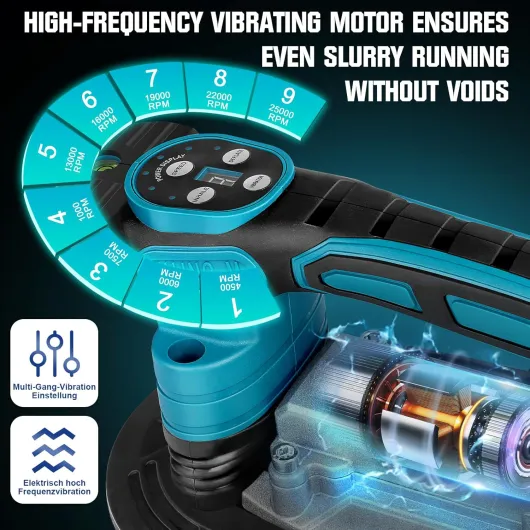
The 9 speed levels are useful. For smaller or more fragile tiles, I kept it around levels 2–4 to avoid overdoing it and shifting everything. For big, heavy tiles or rougher outdoor pieces, I went up to 6–7. Above that, the vibration is honestly a bit too aggressive for my taste, and the noise goes up a lot. But the range is there, and you can adapt depending on the tile size and the adhesive consistency. Compared to a branded Rubi vibrator I use, this one is slightly less smooth in how it ramps up, but the raw power isn’t far off.
On rough or very textured tiles, the 250 kg claim is clearly optimistic. The suction still works, but you feel it’s closer to the limit: if there’s a lot of texture or dust, you sometimes have to reposition the cup or clean the surface to get a proper hold. I had one moment where it started to slide a bit on an outdoor textured tile while vibrating at a higher gear, which makes you pay attention. On smooth tiles and wood‑effect tiles with light texture, no big issues.
For wall tiles, it works but the weight becomes annoying after a while. The vibration helps settle the adhesive and remove air pockets, and I saw fewer hollow sounds when tapping the tiles afterwards. So from a technical standpoint, it’s doing its job. It’s not magic, you still have to know how to lay tiles, but as a helper tool, I’d rate the performance as good but not mind‑blowing. It’s clearly usable on site, especially if you don’t want to spend double on a big brand.
What this tile vibrator actually offers on paper
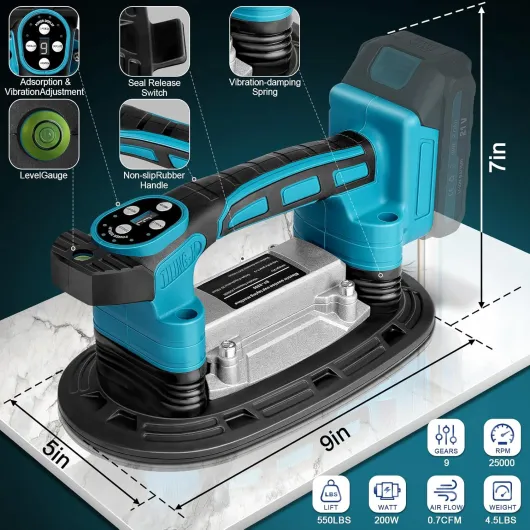
On paper, this tool is a 2‑in‑1 tile vibrator and suction lifter with a rectangular suction cup of 22.5 × 12 cm. The brand isn’t one of the big names; it’s sold under DENEWERK / DEYINENG COMPANY LIMITED, which is basically a generic manufacturer. It’s supposed to handle tiles from 30 cm to 180 cm and up to 250 kg of “adsorption” according to the listing. Let’s be honest: 250 kg is more marketing than real life, but it does have a strong grip when the surface is clean and relatively smooth.
It runs on Makita 18 V Li‑ion batteries (BL1820, BL1830, BL1840, BL1850, BL1860, etc.), but there’s no battery included. That’s important: if you don’t already own Makita batteries and a charger, the total cost suddenly becomes much higher. The tool itself is around 2.6 kg, which you really feel in the arm after a while, especially when working on walls or ceilings.
There are 9 vibration speeds, with a max frequency around 25,000 rpm, controlled by a simple button. You also get a double‑click vent button to release the suction, and a small integrated spirit level on the top to help you keep your tiles straight. Power consumption is around 200 W, but in practice you don’t really care about that; what matters is how long the battery lasts and how strong the vibration is.
Out of the box, you basically get the bare minimum: the machine and that’s it. No battery, no charger, no case, no extra suction cups. For the price, I wasn’t shocked, but if you’re used to more complete kits, this feels a bit spartan. Still, the basics are there: it vibrates, it sticks to the tile, and it takes standard Makita 18 V packs, which was the main selling point for me.
Pros
- Strong vibration with 9 adjustable speeds suitable for tiles from about 30 cm up to large panels
- Compatible with Makita 18 V batteries, handy if you already own BL18xx packs
- Suction cup holds well on clean, smooth to lightly textured tiles and really helps with positioning
Cons
- No battery or charger included, makes it less interesting if you don’t already use Makita
- Heavier and less refined than pro brands; tiring on walls and at high speed
- Suction cup durability on very rough or abrasive tiles is a bit uncertain for intensive daily use
Conclusion
Editor's rating
After using this 2‑in‑1 tile vibrator on several jobs, my opinion is that it’s a practical tool with a few compromises, but overall it does what it promises. The suction is strong enough for most medium and large tiles if the surface is clean, the vibration is powerful with enough speed levels to adapt, and the Makita 18 V compatibility is a real advantage if you already own those batteries. It clearly helps reduce air pockets and makes it easier to adjust big tiles without destroying your wrists.
On the downside, you feel the cheaper side in the plastics, the weight, and the lack of extra features like a clear speed display or included case. The suction cup inspires reasonable confidence but I wouldn’t abuse it every day on very rough tiles without expecting some wear. And the fact that there’s no battery or charger in the box means the real value depends a lot on what you already own.
If you’re a DIYer or small contractor already in the Makita ecosystem and you want a tile vibrator that’s effective and affordable, this model is a decent choice. If you’re a full‑time tiler looking for something ultra‑reliable for daily abuse, or if you don’t have any Makita batteries yet, I’d think twice and compare with pro brands or full kits before ordering. It’s a tool that gets the job done, but it’s not the top of the market either.