Summary
Editor's rating
Value for money: decent if you know what you’re buying
Compact design with decent control but very bare-bones
Powering it from 12V: works fine but watch your setup
Feels okay for hobby use, question mark for long-term duty
Vibration and RPM: good control, limited brute force
What you actually get out of the box
Pros
- Compact 12V brushless vibration motor with integrated speed control and RPM display
- Provides adjustable, stable vibration suitable for small DIY and hobby projects
- Works well with common 12V power supplies and batteries, easy to integrate electrically
Cons
- Very basic documentation and confusing product description (mentions pneumatic despite being electric)
- Exposed control board and average build quality, not ideal for dirty or demanding environments
- Power and durability feel limited for heavy-duty or continuous industrial use

Specifications
View full product page →| Brand | LTUNKHWP |
A tiny 12V shaker that looks like a science project
I picked up this DC brushless 12V vibration motor out of curiosity more than anything else. No big brand, just “LTUNKHWP” and a very generic description. On paper it’s a 30W, up to 7000 RPM vibration motor with a speed regulator and digital RPM display. Basically, a small industrial-style vibrator you can power from 12V or 24V, the kind of thing you’d use on a small hopper, a DIY shaker table, or to shake bubbles out of resin or concrete in small molds.
First impression: it’s tiny. The listing says around 2.5 cm each side and 50 g, and that matches what I got. So forget the idea of a big construction-site concrete vibrator; this is more like a compact module for small setups. I wired it to a 12V bench power supply, then later to a 12V battery pack, just to see how it behaved in more realistic conditions. The built-in controller with digital display is what made me try it instead of a bare motor.
In use, it does what it says: it vibrates, and you can adjust the speed with some precision thanks to the display. But the whole thing feels a bit DIY: no clear manual, brand is unknown, and the documentation is extremely light. You need to already know what you’re doing with DC motors and mounting hardware, otherwise you’ll be guessing a lot. That’s not necessarily bad, but it’s clearly not a plug-and-play gadget for beginners.
Overall, after a few days of testing on a small 3D print powder shaker and a homemade parts vibrator, I’d say it’s a functional little motor with some useful control features, but with a lot of question marks around long-term reliability and actual rated power. It’s the kind of product you buy for experimentation or a one-off project, not something I’d put in a critical setup where downtime would be a big problem.
Value for money: decent if you know what you’re buying
For value, it really depends on how much you pay and what you expect. This is a no-name 12V brushless vibration motor with a built-in controller and RPM display. You’re basically paying for the combo: motor + speed control + feedback, in a compact package. If you compare it to buying a bare motor plus a separate speed controller and a tachometer module, the all-in-one aspect is pretty handy and can actually save you time and wiring hassle.
On the flip side, you’re not getting the things that usually come with a higher-priced, branded unit: clear documentation, proven durability, proper support, and realistic performance curves. Here, you get vague specs and some marketing fluff about “pneumatic motors” that doesn’t even match the product type. So the value is good for tinkerers who are okay with a bit of guesswork, but less convincing if you’re trying to build something that needs certifications or long-term reliability.
Compared to other cheap vibration motors I’ve used (the kind you find on hobby sites), this one sits in the middle: better than the super-basic motors that only do on/off, but obviously below real industrial vibrators that cost several times more. The digital RPM display is the main bonus. If you don’t care about that and just need a motor to shake something, you might find simpler units for less money that will do roughly the same job.
So, in terms of value, I’d say: good enough for DIY and experiments, not a bargain miracle, but not a rip-off either. If you go in knowing it’s a small generic module with limited documentation, you’ll probably be satisfied. If you expect professional-grade kit at a budget price, you’ll be underwhelmed.
Compact design with decent control but very bare-bones
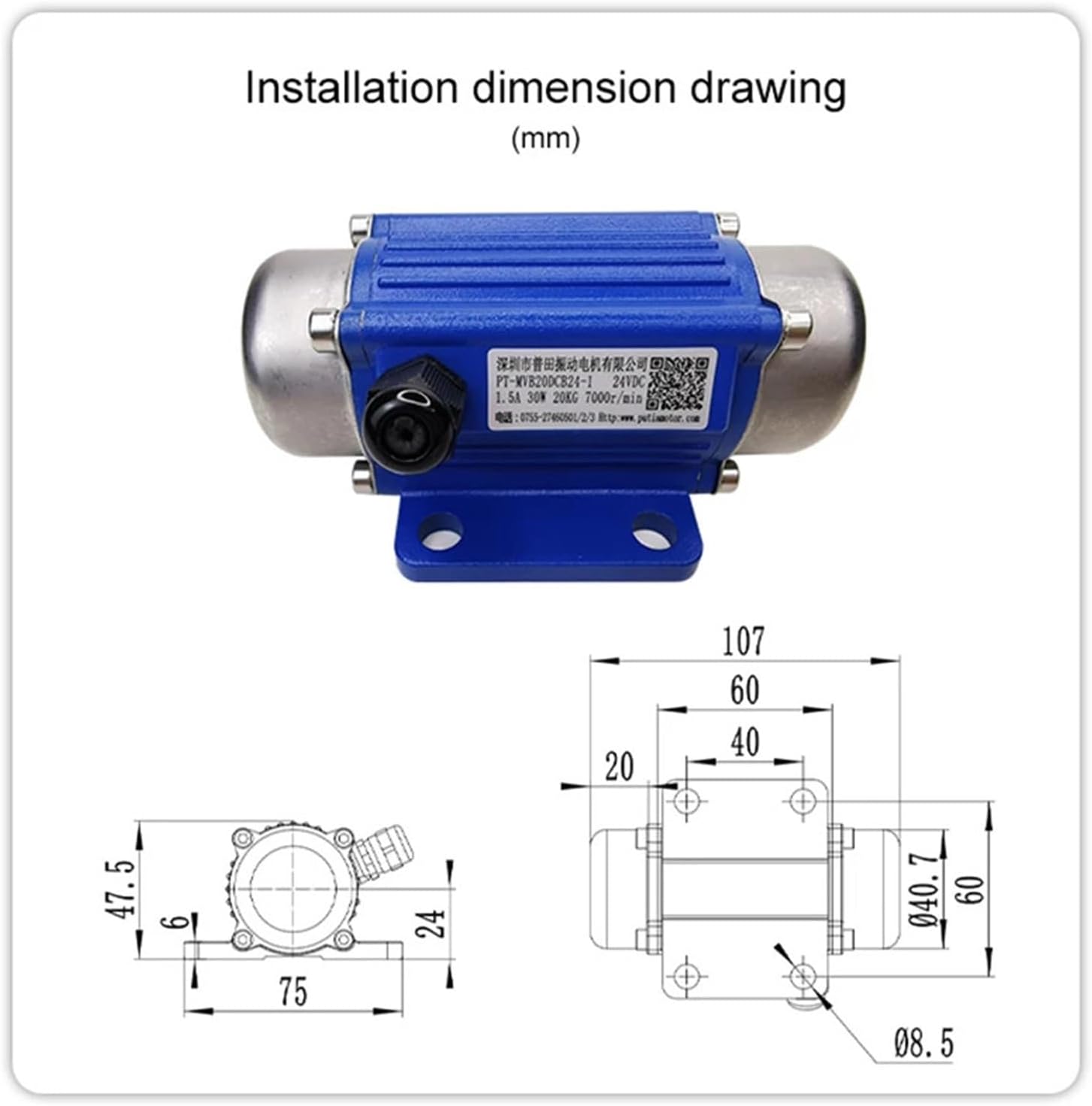
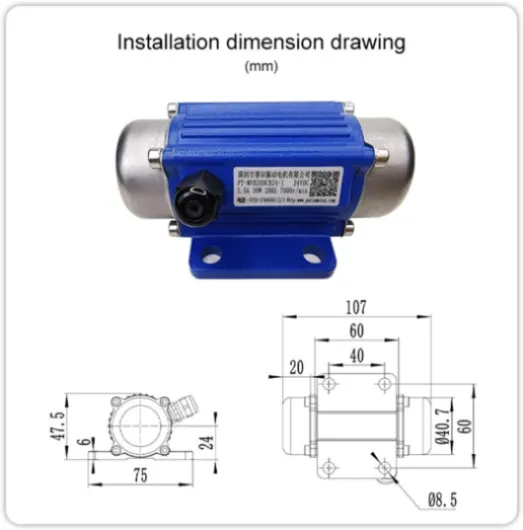
Design-wise, the motor is very compact: roughly a 2.5 x 2.5 x 2.5 cm block for the main body, plus the small control board and display. The size is its main strength: you can fit it in tight spaces, small enclosures, or bolt it onto light structures without worrying about weight. The listing says 50 g, and on my kitchen scale it was around that, so no surprises there. This is handy if you’re making a small vibrating plate or a sorter for 3D-printed parts where you don’t want a heavy motor shaking everything off the table.
The built-in variable speed regulator with digital RPM display is the interesting part. On my unit, the display reacts quickly when you change speed, and the RPM reading felt consistent. I don’t have a lab-grade tachometer, but comparing the sound and vibration at different indicated RPMs, the steps felt logical and repeatable. You can dial the speed down for a gentle shake or push it up near the max for more aggressive vibration. That’s way more practical than a dumb on/off motor where you’d have to play with external PWM or voltage regulators.
However, the design also has some weak spots. The control board is somewhat exposed, with basic soldering and no real protection against dust or accidental knocks. I wouldn’t mount this in a dirty workshop without putting it in a small enclosure. There are no rubber grommets or strain reliefs on the wires either, so if the cable gets pulled, you’re stressing the solder joints directly. That’s the kind of detail where you see it’s a low-cost design and not meant for rough handling.
In short, I’d describe the design as functional and compact, but clearly budget-level. It’s fine for a bench project or a small machine you’ll keep indoors and check regularly. If you need something for continuous industrial use, with proper sealing and mounting options, I’d look for a more professional motor from a known brand. This one feels more like a prototype module that made it straight to retail.
Powering it from 12V: works fine but watch your setup
Even though it’s not battery-powered in the classic sense, the fact that it runs on 12V means you’ll probably hook it up to a power supply or a battery pack. I tested it first on a bench supply at 12V, then on a 12V lead-acid battery from a small UPS, and finally on a DIY 3S Li-ion pack. In all three cases, the motor behaved the same: smooth startup, no weird spikes, and the digital RPM display stayed stable. So from a power standpoint, it’s not picky, as long as it gets a clean 12V line that can deliver enough current.
The listing doesn’t clearly state the current draw, but based on my bench supply readings, at mid speed it was pulling in the ballpark of a couple of amps, with some peaks when ramping up. Nothing too crazy, but you still want a decent 12V source, not a random phone charger with a step-up. On a 7 Ah lead-acid battery, I could run it for several hours at medium power before voltage started to sag. For portable use, that’s actually pretty practical: you can set up a little vibrating station in the garden or in a garage without mains power.
The thing to keep in mind is that the controller and display are exposed, so if you’re running it off a battery in a more mobile setup, protect it from bumps and metal objects. A short across the terminals or on the board would end the fun quickly. Also, there’s no low-voltage cutoff or smart feature: if you drain a Li-ion pack too far, that’s on you. This is a dumb but predictable device: it takes 12V, it spins, that’s all.
In summary, from a “battery and power” perspective, the motor is flexible and easy to feed, as long as you size your supply correctly. It’s perfectly suited for 12V systems like car batteries, small solar setups, or DIY power banks with a proper DC output. Just don’t expect any smart energy management or protections—you have to handle that part yourself.
Feels okay for hobby use, question mark for long-term duty
On durability, I’ll be honest: it’s too early to say how long it will last, but a few things stand out. First, the build quality is average. The housing feels like decent metal, the rotor doesn’t wobble excessively, and there’s no obvious play when you try to move the shaft by hand. So mechanically, it doesn’t feel like complete junk. After a few sessions of 20–30 minutes at different speeds, there was no new noise and no visible damage, which is a good sign.
The weak point is more on the electronics and protection side. The control board is exposed, there’s no conformal coating, and the solder joints look hand-done and a bit rough. In a clean environment, that’s fine. In a dusty workshop or somewhere with metal shavings, I’d be more worried. There’s also no sign of serious waterproofing or sealing, so I would keep it far away from liquids, plaster dust, or concrete splashes. For a “vibration” tool, which often lives in dirty environments, that’s a limitation.
I didn’t notice any overheating or burnt smell during my tests, but I didn’t push it for hours straight either. My gut feeling is that it’s okay for intermittent use: run it for your task, then let it rest. If you want something to run 8 hours a day in an industrial line, I’d look for a more robust motor with a proper IP rating and a known brand behind it. The product page also doesn’t mention any warranty or support beyond what the seller or marketplace offers, which doesn’t help confidence.
So, in terms of durability, I’d rank it as: fine for hobbyists, prototyping, and small DIY tools, but not something I’d trust in a mission-critical role. If it dies, you’ll probably just shrug and replace it, which matches the low-cost, generic nature of the product.
Vibration and RPM: good control, limited brute force
On the performance side, I tested it mainly on three setups: a small metal plate to shake 3D-print cleaning media, a plastic box with screws and bolts to see how well it moves parts around, and a simple resin mold setup to remove bubbles. On 12V, the motor spins up quickly and you can clearly feel the vibration change as you increase RPM. At medium settings, it gives a steady, usable vibration that’s strong enough to move small parts and help powders settle. For light DIY use, it gets the job done.
About the claimed 30W and 7000 RPM: I’m a bit skeptical about the real power. It doesn’t feel like a heavy-duty 30W industrial vibrator; it’s more like a light-duty module. The RPM reading on the display goes up near the claimed value, but in terms of raw shaking force, it’s still a small motor. If you bolt it to a thin metal plate, you’ll get a nice buzz. If you try to vibrate a thick, heavy concrete mold, it’s clearly not enough. So it’s all about matching it with the right size and weight of what you’re trying to shake.
Noise-wise, it’s not silent, but it’s not crazy loud either. At lower speeds, it’s a mild hum with some mechanical buzz. At higher speeds, the pitch goes up and you feel more vibration in the mounting surface. You’ll want to secure it tightly with proper screws or brackets; if you just tape it or loosely clamp it, it tends to rattle and lose efficiency. Heat was reasonable in my tests: after 20–30 minutes at mid-to-high speed, the body was warm but not burning hot. I wouldn’t leave it at full speed for hours on end without checking, though, especially in a closed box.
So overall, performance is decent for small-scale tasks: it’s fine for light materials, small containers, or DIY projects. If you expect something that can handle big concrete forms or heavy industrial hoppers, you’ll be disappointed. It’s more of a precise little shaker than a powerhouse. For the price and size, I’d say the performance is acceptable, but nothing more.
What you actually get out of the box
Out of the box, the motor comes as a small block with an eccentric weight built into the rotor and a tiny control board with a digital display. There’s no fancy branding, no glossy leaflet, just the unit in basic packaging. The product page talks about “pneumatic motors”, which is confusing because this thing is absolutely not pneumatic; it’s a DC brushless electric motor. So right away, you see some copy-paste in the listing, which doesn’t build much confidence.
The model I tested is the 12V 30W, 7000 RPM version. The label on the board mentions the voltage and some basic wiring hints, but there’s no proper datasheet. You basically get: motor, integrated speed controller, a few wires already soldered, and that’s it. No screws, no mounting brackets, no connectors. If you’re used to industrial gear with clear specs and torque curves, you’ll find this a bit bare-bones. It’s more on the level of generic AliExpress modules than anything you’d associate with a known industrial brand.
In practice, setting it up is straightforward if you’ve done any basic DC projects: connect 12V and ground, and it starts up. The digital display shows the RPM, and there’s usually a small knob or buttons to change the speed. The display is readable enough at arm’s length, even in a moderately lit workshop. There’s no fancy menu, no app, nothing like that—just RPM feedback and manual control, which honestly is all you need for this kind of tool.
My main criticism on presentation is the lack of clear specs and use cases. There’s no stated continuous duty rating, no maximum recommended on-time, and no guidance on mounting orientation. So you’re left to test and see where it starts to get hot or noisy. For a hobbyist, that’s acceptable. For anything professional, it’s a bit weak. The product “presentation” basically screams: cheap generic module, figure it out yourself.
Pros
- Compact 12V brushless vibration motor with integrated speed control and RPM display
- Provides adjustable, stable vibration suitable for small DIY and hobby projects
- Works well with common 12V power supplies and batteries, easy to integrate electrically
Cons
- Very basic documentation and confusing product description (mentions pneumatic despite being electric)
- Exposed control board and average build quality, not ideal for dirty or demanding environments
- Power and durability feel limited for heavy-duty or continuous industrial use
Conclusion
Editor's rating
After playing with this DC brushless 12V vibration motor for a while, my conclusion is pretty simple: it’s a small, functional shaker with handy speed control and RPM display, wrapped in very basic packaging and branding. It does what it’s supposed to do for light tasks: vibrate small plates, help settle powders, move screws and bolts around, or shake bubbles out of small molds. The integrated speed regulator makes it much easier to dial in the intensity compared to a dumb on/off motor, and the 12V power requirement fits nicely with common bench supplies and batteries.
Where it falls short is on clarity and confidence. The listing is sloppy (mentioning pneumatic motors for an electric device), the documentation is almost nonexistent, and the build quality is clearly budget-level. I’d trust it for hobby projects, lab experiments, or occasional workshop use, but not for a machine that has to run all day, every day. If you’re a tinkerer who’s comfortable wiring and protecting your own electronics, you’ll probably find it useful and decent for the price. If you want plug-and-play reliability with proper support, you should probably look at better-known brands, even if that means paying more.