Summary
Editor's rating
Is it good value for money if you already have air?
Industrial design, minimal safety, very function-first
Basic packaging and barebones documentation
Built like a shop tool, but air quality will matter
How well it actually mixes paint and ink
What you actually get out of the box
Pros
- Mixes 1–5 kg paint and ink cans evenly in about 10–15 minutes with less effort than hand shaking
- Pneumatic drive handles long sessions without motor overheating and works in non-electric or hazardous environments
- Adjustable clamp fits a wide range of round and square containers (about 1–5 L) and holds them securely when set correctly
Cons
- Requires a decent air compressor, fittings, and some pneumatic know-how to set up properly
- Generic brand with basic documentation and no obvious spare parts or strong after-sales support
- No safety cage, timer, or advanced controls; design is very barebones and not ideal for inexperienced users

Specifications
View full product page →| Brand | Generic |
A weird-looking shaker that actually saves you time
I’ve been using this generic pneumatic paint mixing shaker for a few weeks in a small workshop setup. I mainly run automotive paints, primers, and some thicker inks for screen printing. On paper, it looks a bit overkill: compressed air, oscillation up to 500 shakes a minute, adjustable clamp, works with round and square cans. In practice, it’s basically a mechanical arm that does the boring shaking for you while you prep other stuff.
Before this, I was either hand-shaking 1L cans like a caveman or using a cheap electric vortex mixer that hated anything thicker than water. With this shaker, I can throw in 1–5 kg cans, clamp them down, set the air, and let it go for 10–15 minutes. The mix is clearly more uniform, especially for older paints that have been sitting and separated badly. I don’t have to fight with chunks at the bottom as much.
It’s not plug-and-play, though. You need a compressor that can keep up and decent air fittings. The first day I spent more time figuring out the air pressure sweet spot and clamp adjustment than actually mixing. Once dialed in, it became part of the routine: load, clamp, open air, walk away. It’s noisy and a bit industrial, but that’s kind of expected from a pneumatic rig.
If you’re expecting a polished, branded machine with fancy buttons and a manual written in perfect English, this isn’t it. It’s a fairly barebones, workshop-style tool that focuses on one thing: shaking cans reliably without burning out a motor. If that’s what you need and you already have compressed air in your space, it starts to make sense. If you’re just painting a bedroom once a year, this is way too much machine.
Is it good value for money if you already have air?
Value really depends on your setup and how often you actually mix paint or ink. If you already have a decent compressor and you’re regularly handling 1–5 L containers – auto paint, wood coatings, inks, that sort of thing – this shaker starts to look like a pretty solid deal. It saves your arms, gives more consistent mixes, and can run long sessions without worrying about electric motors overheating. For a small body shop or print shop, that can easily justify the cost over time.
Where the value drops is if you’re only using it occasionally or don’t have compressed air. Buying a compressor just to run this machine would make no sense for most people. Also, since it’s a generic brand, you’re not paying for after-sales support or easy spare parts. You’re essentially buying a tool that you expect to use until it dies, then either fix yourself with generic parts or replace. For the right price bracket, I’m okay with that, but it’s something to keep in mind.
Compared to small electric mixers I’ve used, this pneumatic shaker handles heavier loads and can run longer, but those electric units are often cheaper and simpler to set up. If you only work with 1L cans and low-viscosity stuff, an electric vortex mixer might be more cost-effective and takes less bench space. This shaker really makes sense when you’re in that 2–5 kg, medium-to-high viscosity zone, and you’re doing it often enough that manual shaking or stirring is becoming a time sink.
So in terms of value, I’d call it “good but situational”. In a workshop that already runs air tools and needs regular mixing, it gets the job done and pays for itself in saved time and more reliable results. In a casual or home setting, it’s probably overkill and the money would be better spent on simpler tools or pre-tinted paints. If you fit the target use case, though, the cost-to-benefit ratio is pretty reasonable.
Industrial design, minimal safety, very function-first
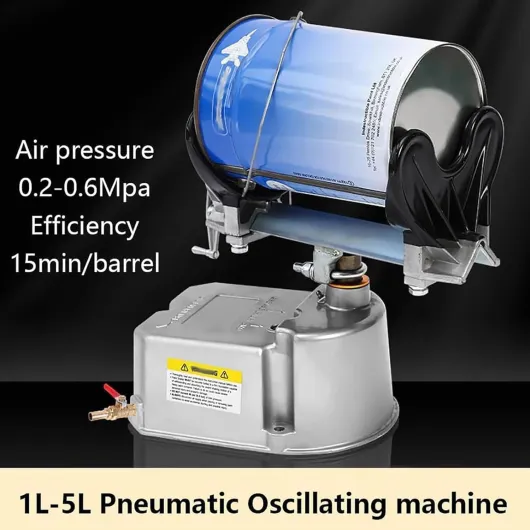
The design is pretty straightforward: a metal base that sits on the bench, a vertical structure holding the clamp, and a pneumatic cylinder that drives the rocking motion. The clamp has grooves inside the jaws to catch the edges of round or square cans, and a manual tightening handle to lock everything down. There’s no enclosure around the moving parts, no soft edges, no fancy paint job. It’s basically raw hardware built to move a can back and forth.
The 30° swing angle is actually a good compromise. It’s enough movement to really churn the contents, but not so aggressive that the can feels like it’s about to launch out of the clamp. When I ran it near full speed with a 4L can of basecoat, the frame shook a bit but stayed put on the bench. I still ended up bolting it to the table because I don’t trust heavy vibrating gear just sitting loose, but technically you can run it freestanding if your bench is solid.
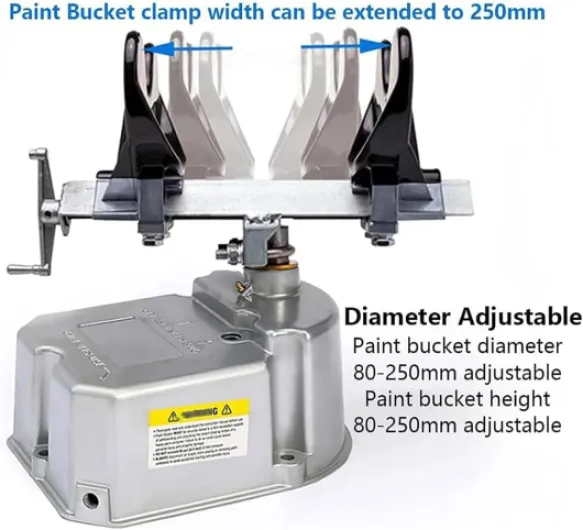
Adjusting for different can sizes is done by loosening the handle, sliding the clamp arms, and retightening. It’s a bit crude but it works. Switching from a 1L round can to a 4L square can took maybe a minute once I got used to it. There’s no scale or markings to tell you exactly where to place things; you eyeball it and test. I’d have liked some basic guides or stops so you can quickly repeat the same position for commonly used can sizes.
One design downside: there’s no integrated air filter, lubricator, or regulator. You’re expected to manage that upstream on your air line. If your workshop air is dirty or you don’t regulate the pressure well, you’ll either wear the cylinder faster or run it too weak/too hard. I’d call the design honest but basic: it’s built for people who already know how to deal with pneumatic tools and aren’t afraid of a bare mechanism moving fast right in front of them.
Basic packaging and barebones documentation
The packaging is clearly focused on just getting the machine to you in one piece, not on presentation. Mine came in a plain cardboard box with foam and some plastic wrap around the main body. No glossy photos, no fancy branding, just enough padding so the metal parts don’t smash into each other during shipping. To be fair, that’s all I really need for something like this, but if you’re used to polished retail packaging, this feels very utilitarian.
Documentation is where it shows its generic side. The manual was short, with slightly awkward English and only the basic steps: connect to air, adjust pressure, clamp the barrel, start oscillation. It did list the key specs like pressure range (0.2–0.6 MPa), weight range (1–5 kg), and barrel size limits, but there were no detailed diagrams or troubleshooting tips. No clear safety section either, beyond a couple of lines about not putting your hands near moving parts and keeping the pressure within range.
There were no air fittings or hoses included in my box, just the machine itself and the clamp hardware. That means you need to already have a compressor, hose, and compatible fittings, or be ready to buy them separately. Not a big deal if you’re in a workshop that already runs air tools, but someone expecting a full kit might be disappointed. I had spare fittings, so I was up and running after about 20–30 minutes of setup and leak checking.
Overall, the packaging and included materials are “just enough”. The machine arrived intact, nothing was missing, but don’t expect a lot of hand-holding. You need to be comfortable figuring out some details on your own, like exactly how much to tighten the clamp for different cans or what pressure works best for your materials. For someone used to industrial or semi-industrial gear, it’s fine. For a casual DIY user, it might feel a bit rough and under-explained.
Built like a shop tool, but air quality will matter
Durability is always a bit of a guess with generic gear, but after a few weeks of regular use, I can at least say it feels sturdy. The frame is metal, the clamp parts are thick enough, and nothing feels flimsy or bent after handling multiple 4L cans. The pneumatic cylinder is the main moving part, and if anything is going to fail long term, it’ll probably be seals in there or the pivot joints on the oscillating arm.
I’ve run it mostly at mid to high pressure (around 0.4–0.6 MPa) with loads between 2 and 4 kg. No visible loosening of bolts, no weird play in the joints yet. I did go over the screws once with a wrench after the first few days just to be safe, because any vibrating machine tends to slowly back things out. After that, everything has stayed tight. The clamp handle threads still turn smoothly, and the grooves on the jaws haven’t rounded off, even with metal cans clamped hard.
The catch is, like any pneumatic tool, its lifespan is tied to your air setup. If you run wet, dirty, unregulated air, don’t expect miracles. I have a basic filter/regulator/oiler on my compressor line, so the cylinder is getting reasonably clean air and a bit of lubrication. Under those conditions, I’d expect it to last a good while. If you go straight from a cheap compressor with no filtration, moisture and dirt will chew through the internals faster. That’s not unique to this machine, it’s just how pneumatics work.
There’s no branding or obvious spare parts source listed, which is a downside for long-term durability. If the cylinder dies in three years, you’ll either have to hunt for a compatible part or replace the whole thing. For the price range this usually sits in, that might still be acceptable for a workshop that uses it regularly. I’d rate durability as promising but unproven: the construction looks solid, but you’re betting on a generic cylinder with no official support channel.
How well it actually mixes paint and ink
Performance-wise, this is where the shaker actually earns its spot. The specs say up to 500 oscillations per minute, and while I didn’t count, at higher air pressure it moves fast enough that the whole can is clearly getting a serious workout. I tested it on three main things: old separated automotive basecoat, thicker primer with a lot of solids, and screen printing ink that had sat for months. In all three cases, 10–15 minutes on the shaker gave me a noticeably more uniform mix than my usual hand shaking or stirring.
On a badly separated 1L can of metallic basecoat, I did a simple test: pour a bit before mixing, then mix 10 minutes on the shaker and pour again. Before, you could see a lighter, thinner layer on top and heavier pigment stuck at the bottom. After, the color and consistency were much more even, and there were far fewer chunks when I scraped the bottom with a stick. It wasn’t magic – I still like to give it a quick stir – but the heavy lifting was done by the machine.
With a 4L can of high-build primer (thicker stuff), I had to push the air pressure closer to 0.6 MPa to get a strong enough shake. After 15 minutes, the primer poured more consistently, and spraying it felt more predictable. I didn’t get those random thick clumps that sometimes clog the gun when the solids aren’t fully re-suspended. For screen ink, which is quite viscous, it helped loosen it up, but I still had to finish with a spatula. So for very thick materials, it’s helpful but not a total solution.
One thing I noticed is that the machine runs cooler and more consistently than my old electric mixer during long sessions. Because it’s pneumatic, there’s no motor overheating or tripping. I ran several 15-minute cycles back-to-back on a busy day, and aside from the compressor working hard, the shaker itself didn’t complain. Noise-wise, it’s loud – between the compressor and the chattering of the mechanism, it’s not exactly quiet, but in a workshop environment it’s acceptable. Overall, in terms of mixing performance, I’d say it’s pretty solid: not perfect for super heavy paste, but very effective for typical paint and ink in the 1–5 kg range.
What you actually get out of the box
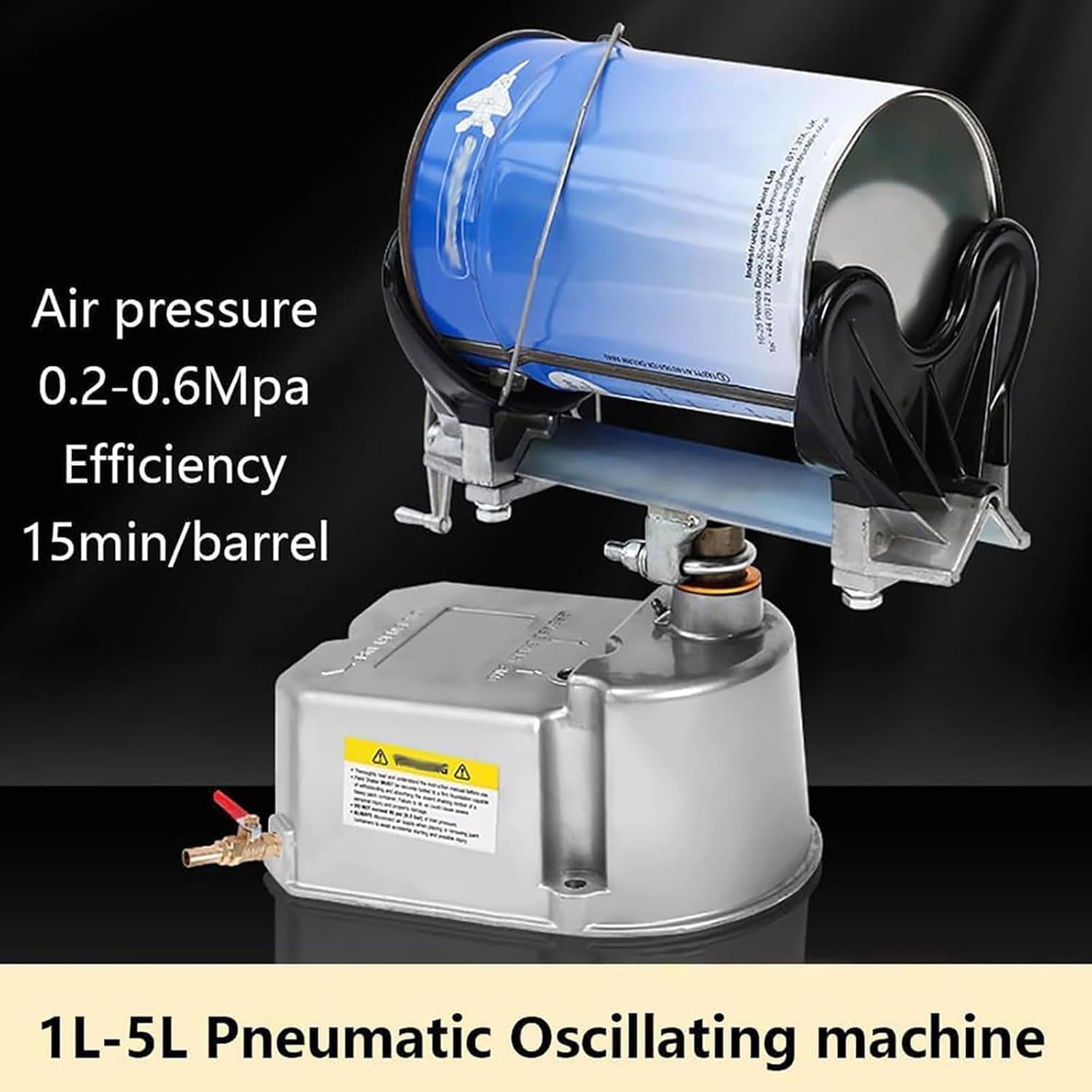
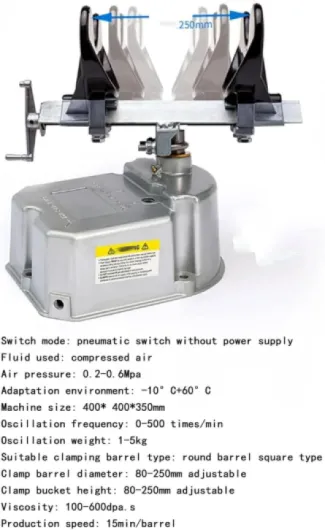
Out of the box, this thing looks like a no-name industrial tool more than a consumer gadget. There’s the main body with the pneumatic cylinder, a desktop frame, the adjustable clamp arms with those grooved jaws for the cans, and a simple tightening handle. No fancy branding, no digital display, no timer. You hook it up to compressed air, adjust the clamp for your can, and control speed with the air flow. That’s pretty much it.
The specs say it can handle cans from 80–250 mm in diameter and 80–250 mm in height, which covers most 1–5 L paint and ink containers I have. I tried it with 1L metal cans, 4L square thinner cans, and plastic ink buckets around 3 kg. As long as I took a minute to center and clamp them properly, it held everything without slipping. The 1–5 kg weight range feels realistic: under 1 kg you just don’t need this machine, and above 5 kg I wouldn’t trust the clamp or the frame.
The oscillation is a 30° swing left-right, not a spinning motion. So the can rocks back and forth fast instead of rotating. With the air pressure turned up near the top of the 0.6 MPa range, it moves fast enough that you probably don’t want to put your fingers near it. There’s no built-in safety cage or switch, just basic mechanical movement. This is clearly aimed at people comfortable around workshop tools, not first-time DIYers.
In terms of overall presentation, it feels like a piece of equipment you’d find in a back-room mixing area, not on a shop floor for customers to admire. I’m fine with that. I prefer that they spent the cost on the cylinder and the clamp rather than a plastic shell. But if you’re used to nicely finished branded tools, the generic look and minimal documentation might surprise you. You have to be okay with a bit of trial-and-error setup.
Pros
- Mixes 1–5 kg paint and ink cans evenly in about 10–15 minutes with less effort than hand shaking
- Pneumatic drive handles long sessions without motor overheating and works in non-electric or hazardous environments
- Adjustable clamp fits a wide range of round and square containers (about 1–5 L) and holds them securely when set correctly
Cons
- Requires a decent air compressor, fittings, and some pneumatic know-how to set up properly
- Generic brand with basic documentation and no obvious spare parts or strong after-sales support
- No safety cage, timer, or advanced controls; design is very barebones and not ideal for inexperienced users
Conclusion
Editor's rating
After using this generic pneumatic paint mixing shaker in a real workshop routine, I’d sum it up as a solid, no-frills tool for people who actually move a lot of paint or ink. The mixing performance is clearly better than hand shaking and more capable than the small electric mixers I’ve owned, especially with 2–5 kg cans and medium-viscosity materials. It runs off compressed air, so it can go for repeated 15-minute cycles without any sign of overheating, and it handles both round and square containers within the 1–5 L range without much drama once you get the clamp adjusted.
On the flip side, it’s not user-friendly in a consumer sense. The design is bare, the documentation is minimal, and you need a proper compressor plus some basic understanding of pneumatics to get the best out of it. There’s no safety cage, no timer, and no branded support channel if something breaks. It’s more like buying a generic piece of shop equipment than a polished product. If you’re a small auto body shop, woodworking shop, or print studio with existing air lines, it’s a practical workhorse that gets the job done and can save time and effort. If you’re a casual DIY painter or don’t already own a compressor, you’re better off with a simpler electric mixer or just manual methods.