Summary
Editor's rating
Value for money: fine for tinkerers, less so for serious industrial use
Simple design, clearly made to be a component, not a finished device
Power and power supply: no battery, but easy enough to feed
Build quality and how it holds up with use
Vibration and RPM: decent punch for the size, but limited range
What you actually get in the box
Does it actually get the job done for real projects?
Pros
- Compact 12V brushless vibration motor with adjustable speed and digital display
- Enough vibration strength for small parts, light trays, and DIY test rigs
- Good value for hobby and prototyping use where you want simple RPM control
Cons
- Barebones design with exposed controller and minimal documentation
- Limited vibration power, not suitable for heavy structures or continuous industrial duty

Specifications
View full product page →| Brand | LTUNKHWP |
A tiny 12V vibrator motor that looks simple on paper
I picked up this LTUNKHWP DC brushless 12V vibration motor because I needed a small shaker for a DIY project, not for anything industrial. The product page is pretty vague, but the idea is simple: a small brushless motor, 12V, about 10W, and it’s supposed to hit 3000 RPM with a built-in speed regulator and digital display. No big brand name, no big promises, just a compact unit that’s supposed to vibrate things.
First impression when it arrived: it’s tiny. The listing says around 50 g and the box is about 2.5 cm per side, which matches what I saw. This is not a big concrete-form vibrator or something for heavy machinery. It’s more like a little module you’d stick on a small test rig, a feeder tray, or maybe a mini massage or hobby setup if you know what you’re doing with wiring. If you expect a beast, you’ll be disappointed right away.
I wired it up to a regular 12V DC power supply I already use for LED strips and small motors. There’s no real documentation in the box, at least not in my case. Just the motor unit and the controller module with the digital RPM display. So you need to be at least a bit comfortable with DC polarity and basic electronics. If you’re waiting for a nice manual with diagrams and safety notes, forget it.
Overall, my first takeaway after a few days of messing with it: it does vibrate, it does spin, and the speed control roughly works. But it’s clearly a budget component. It’s the kind of thing that’s fine for experiments and light duty, not something I’d trust in a critical machine that runs all day. If you go in with that mindset, you won’t be too surprised by what you get.
Value for money: fine for tinkerers, less so for serious industrial use
On the price side, this kind of no-name vibration motor with a controller usually sits in the low to mid budget range. You’re paying for a small brushless motor plus a basic speed controller with a display, not for a polished industrial product. For a DIYer, student, or hobbyist, that’s actually pretty attractive: you get enough features to play with vibration, adjust speed, and see a rough RPM value without buying a separate driver or fancy lab gear.
Compared to more established industrial brands, you obviously save money, but you also lose a few things: proper documentation, clear duty cycle specs, and reliable support. If it fails, you’re mostly on your own. For me, as someone who just wanted to test vibration on small setups, that trade-off is acceptable. I’d rather pay less for something that "gets the job done" than overspend on an overkill unit for casual projects. But if downtime costs you money, the cheap route can end up being more expensive in the long run.
The thing I liked is that, for the price, you do get a functional system: motor + speed control + display. You don’t have to build your own driver from scratch. It’s basically a plug-into-12V-and-tune setup, as long as you’re okay with basic wiring. That alone saves time and some frustration, especially if you’re just experimenting and don’t want to mess with PWM controllers or custom electronics.
On the downside, the vague specs and generic branding don’t inspire a lot of confidence for critical use. If you want repeatable performance, traceable specs, and long-term reliability, I’d say this is decent but nothing more. It’s good value for small, non-critical projects and learning. For anything beyond that, I’d treat it as a starting point, not the final solution. In other words: fine for the garage or lab bench, less convincing for a production line.
Simple design, clearly made to be a component, not a finished device
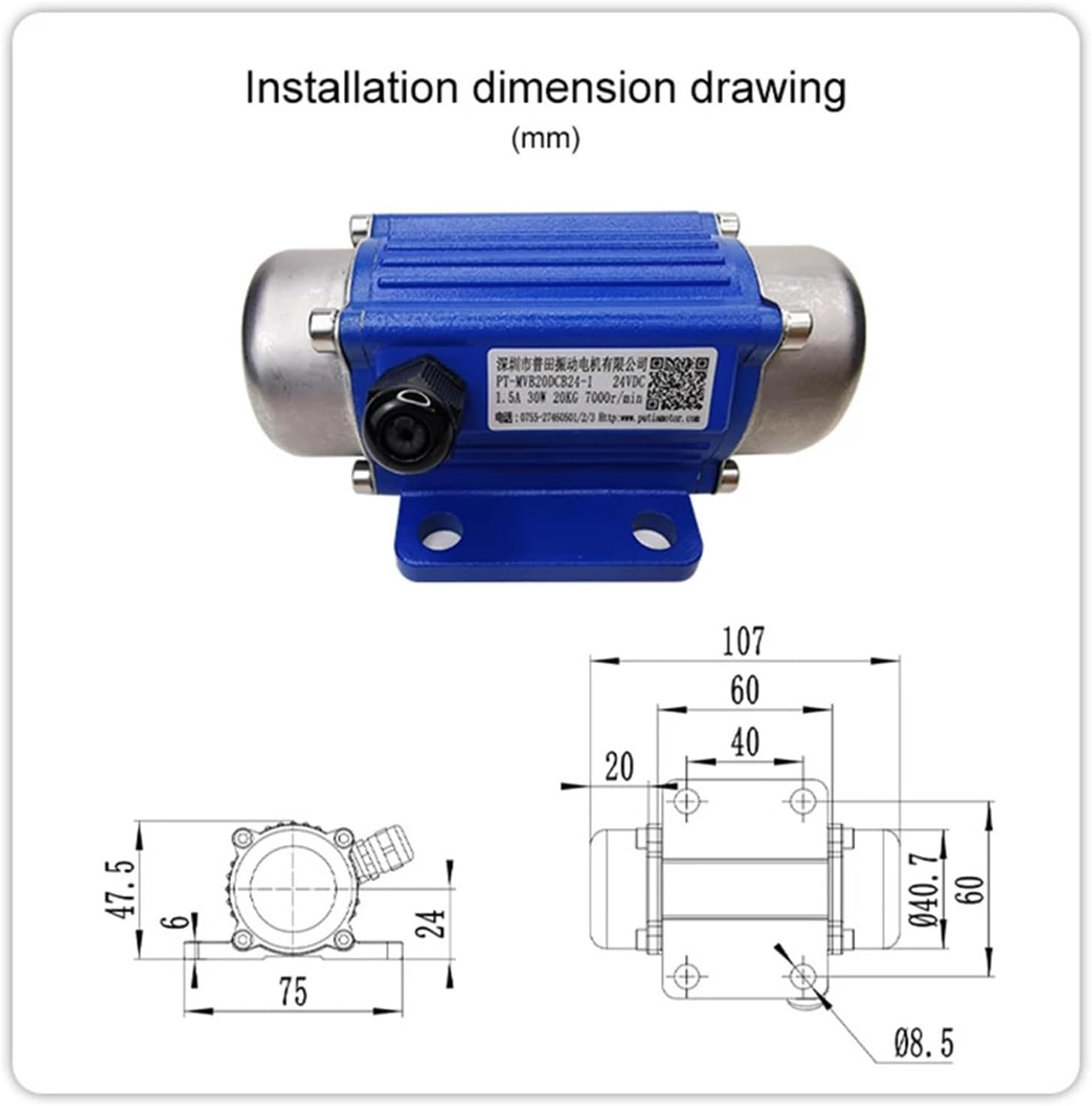
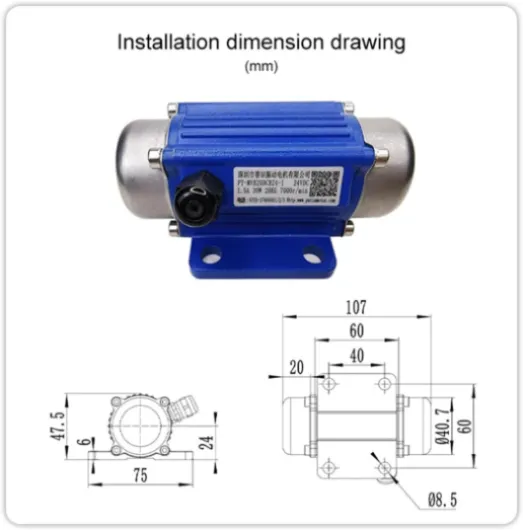
Design-wise, it’s as straightforward as it gets. The motor is a compact cylinder with an off-center weight inside to create vibration when it spins. The outer shell feels like standard metal housing, nothing fancy, and there are basic points where you can mount or clamp it. It’s not really designed with nice brackets or rubber feet. You’ll probably have to improvise mounting using clamps, 3D-printed holders, or just bolt it to a plate if you want something stable and repeatable.
The controller board is exposed, with the digital display on one side and the connections on the other. No real casing around it, at least on the unit I got. This tells you right away that it’s meant to go inside a project box, control cabinet, or some DIY enclosure. Leaving it loose on a workbench is asking for dust, metal shavings, or a dropped screwdriver to short something. The layout is clear enough though: power in, motor out, basic controls. The text on the board is small but readable if you have decent lighting.
One thing I liked is the simplicity of the interface. You basically plug in 12V DC, connect the motor, and you can adjust speed. The display gives you a number that increases and decreases with speed, which is helpful to get repeatable settings. That said, I wouldn’t treat the displayed RPM as lab-grade accurate. It’s more of a reference than a precise measurement, but for most small projects that’s fine. You just note, for example, that around "2500" on the display gives you the vibration level you want.
If I compare it with more polished industrial vibration units I’ve seen at work, this one is clearly in a different league. Those have robust housings, proper mounting ears, cable glands, and IP ratings. Here you get a bare module. For the price and the target use (hobby, light prototyping, maybe small feeders), that’s acceptable. Just don’t expect it to be plug-and-play or rugged out of the box. You’ll need to think a bit about where and how you mount both the motor and the controller if you want a clean and safe setup.
Power and power supply: no battery, but easy enough to feed
There’s no built-in battery with this thing, which is normal for this kind of component. It expects a stable 12V DC source. I ran it off a generic 12V, 2A switching power supply I already had, the kind people use for LED strips, and that was more than enough. At 10W rated power, you’re looking at under 1A of current at full speed, so anything that can deliver 1–2A at 12V should be fine. Just don’t cheap out with a super weak wall wart or you’ll get unstable performance and possible flickering on the display.
For fun, I also tried running it off a 12V lead-acid battery from a small UPS, and it worked fine. That setup actually made sense for a portable rig where I didn’t have mains power nearby. The motor didn’t seem picky about the exact voltage as long as it stayed in a reasonable range. Obviously, if you drop too low below 12V, the maximum speed and vibration strength go down. I wouldn’t push it above spec either – feeding 15–16V just to get more punch is a good way to shorten its life or fry the controller.
One thing to keep in mind is that there’s no reverse polarity protection mentioned anywhere. So if you wire the power backwards, you might damage the controller or the motor. This is why I’d recommend using a small fuse and double-checking polarity before you power it up. For people who are used to plug-and-play stuff, this might feel annoying, but that’s the reality with cheap DC components: you’re the one responsible for not messing up the wiring.
In short, powering it is simple but not idiot-proof. No battery, no fancy power system, just 12V DC in. If you already have a bench supply or a 12V brick, you’re good to go. If not, factor in the cost of a decent power supply, because running it off some random old adapter you found in a drawer might cause more problems than it solves.
Build quality and how it holds up with use
Durability is where I’m a bit cautious. The motor is brushless, which is good news in theory because it means fewer parts that wear out quickly compared to brushed motors. After a couple of weeks of on-and-off testing – short sessions of 10–20 minutes, several times a day – it’s still running fine. No weird noises, no obvious play in the shaft, and no burnt smell. So for light use, it seems okay so far. But I wouldn’t call it bulletproof either.
The overall construction feels like typical budget hardware. The housing is fine, but there’s no clear sealing, no mention of IP rating, and no serious protection against dust or moisture. If you plan to use it in a dusty workshop or near fine powder, I’d at least cover or box in the controller board. I had it running near some wood dust, and I quickly realized leaving the board exposed was a bad idea. I ended up putting it in a simple plastic project box with openings just for the display and wiring.
Heat-wise, the motor gets warm at higher speeds but not crazy hot in the conditions I used it. Still, if you intend to run it for hours non-stop, I’d keep an eye on temperature, especially if it’s mounted in a tight space with no airflow. Long continuous use at full speed on a cheap, compact motor is usually how you shorten its life. For intermittent duty, like testing and small runs, it feels acceptable. Just don’t treat it like a 24/7 industrial vibrator, because it’s not built or priced for that.
So my honest take: for hobby and light prototyping it’s okay, but if your goal is something that runs every day in a harsh environment, I’d look for a better-known brand with clearer specs and proper protection. This one is fine as a low-cost component to experiment with, and if it dies after a while, it’s not the end of the world. Just don’t build your entire production process around it and expect it to last forever.
Vibration and RPM: decent punch for the size, but limited range
In terms of raw performance, for a 10W, 12V, 3000 RPM motor, it behaves pretty much as you’d expect. When I cranked it near the upper end of the speed range, it produced a noticeable vibration that you can clearly feel if it’s fixed to a small metal plate or plastic box. I used it on a small test rig to shake a container with screws to see if they would move along a chute, and it managed to keep them moving, but only on a lightweight setup. On heavier metal plates, the vibration was clearly weaker and less effective.
The listed 3000 RPM feels realistic. The motor spins up fairly quickly and doesn’t stall easily under light loads, but remember this is a vibration motor, not a drive motor. You’re not attaching a belt or a gear to it. The off-balance weight inside is small, which is fine for small-scale vibration but not enough if you want to shake something heavy like a big hopper or concrete mold. If you try to force it into that kind of job, you’ll just end up with mild buzzing instead of strong shaking.
Speed control works reasonably well. You can go from a soft buzz at low RPM to a more aggressive vibration near the top. The frequency change is noticeable, and it’s useful if you’re trying to tune the vibration to a specific material, like small plastic pieces versus heavier bolts. The motor does make a bit of noise at higher speeds – more of a whirring and buzzing – but nothing crazy for a small motor. If you mount it on a resonant surface, the noise obviously gets worse, but that’s more about your setup than the motor itself.
After running it in short sessions of 10–20 minutes at medium to high speed, it got warm but not scorching. I wouldn’t leave it at full power for hours in a closed box without ventilation, but for intermittent use it held up fine. For the size and power rating, I’d say the performance is pretty solid as long as you keep your expectations realistic: it’s for small and light vibration tasks, not industrial-level shaking.
What you actually get in the box
The product listing throws a lot of words around: "DC brushless", "high frequency", "variable frequency", "speed regulator", "digital display". In reality, what showed up for me was a small vibration motor body and a simple controller board with a little LED display, all pretty barebones. No fancy housing, no mounting templates, just basic parts. The brand name LTUNKHWP doesn’t ring any bells, and the packaging confirms that this is more of a generic component than a polished finished product.
The motor itself is compact and light, around 50 g as advertised, and roughly the size of a large coin in thickness and diameter. The controller has a small digital display showing RPM or at least a value that behaves like RPM when you change the speed. There’s a knob or buttons (depends on the variant) to adjust the speed. You’ll need your own 12V DC power source; nothing is included for that. There’s also no pre-crimped connectors or plug-and-play system. You’re basically expected to screw or solder wires where they belong.
On the product page they also mention 24V, but the specific version I used is the 12V, 10W, 3000 RPM model. Don’t expect a lot of clear labeling between the 12V and 24V options; you have to pay attention when ordering. The motor casing is marked but the markings are tiny. If you mix them up, you could either underpower it (and get weak vibration) or fry it if you’re careless with voltage.
In practice, I see this as a small kit: you get the core motor and a basic controller, and the rest is up to you. It’s not like a consumer product with a power plug and on/off switch ready to go. If you’re used to Arduino-type modules and small Chinese components from marketplaces, the vibe is similar: low guidance, low polish, but functional if you know roughly what you’re doing.
Does it actually get the job done for real projects?
For my use, I mainly wanted something to help move small parts along a chute and to test how powders behave under vibration. On that front, the motor did the job. When mounted on a small aluminum plate under a plastic funnel, it helped keep fine powder from bridging and sticking. It’s not magic – you still have to design the funnel angle correctly – but the vibration helped material flow more smoothly. With small screws and nuts, it managed to keep them from jamming in a narrow tray, as long as the tray wasn’t too heavy or overbuilt.
Where it shows its limits is when you try to push it beyond what a 10W motor should reasonably handle. I tried bolting it to a thicker steel plate (around 4–5 mm) to see if I could get strong vibration over a bigger surface. The result was pretty underwhelming. You could feel the vibration if you touched the plate, but visually and functionally, it didn’t do much. That’s not really the motor’s fault; it’s just not powerful enough to efficiently shake heavier structures. If you know you need to move a lot of mass, you should look at much larger, higher-wattage units.
One thing I found practical is the adjustable speed with the digital display. When testing different materials, I could note down that, for example, setting "1800" on the display was good for a certain powder, while "2500" worked better for small metal parts. It’s not scientific, but it’s repeatable enough for DIY work. That’s a lot nicer than a fixed-speed vibration motor where you’re stuck with one intensity and have to hack your own PWM or voltage control.
Overall, I’d say the effectiveness is nothing special but clearly usable. If your project is small-scale and you understand that it’s a light-duty vibrator, it will get the job done. If you expect it to replace a proper industrial vibrator on a big hopper or a heavy table, you’ll be disappointed. It’s best suited for hobby setups, small lab-style rigs, and learning or prototyping where you don’t want to spend a lot on more serious equipment.
Pros
- Compact 12V brushless vibration motor with adjustable speed and digital display
- Enough vibration strength for small parts, light trays, and DIY test rigs
- Good value for hobby and prototyping use where you want simple RPM control
Cons
- Barebones design with exposed controller and minimal documentation
- Limited vibration power, not suitable for heavy structures or continuous industrial duty
Conclusion
Editor's rating
Overall, this LTUNKHWP DC brushless 12V vibration motor with speed regulator is a pretty solid little tool for tinkerers and light-duty projects. It vibrates as advertised, the speed control works, and the digital display is handy for getting roughly repeatable settings. For moving small parts, helping powders flow, or just experimenting with vibration in a DIY setup, it does the job without too much fuss, as long as you already have a decent 12V power supply and you’re comfortable with basic wiring.
Where it falls short is when you expect industrial-level build quality, long-term durability under heavy use, or clear, detailed specs. The design is barebones, the controller board is exposed, and there’s no real documentation to guide you. It’s not something I’d trust in a harsh environment or in a machine that has to run all day, every day. But used within its limits, it’s a low-cost way to add controlled vibration to a project.
If you’re a hobbyist, student, or small-scale experimenter, this is a reasonable buy: cheap enough, functional, and flexible. If you’re an industrial user or you need rock-solid reliability and support, I’d skip this and look for a better-known brand with proper enclosures and clear ratings. In short: good value for casual, light use; not ideal for serious, continuous-duty work.