Summary
Editor's rating
Value for money: cheaper than hiring if you pour regularly
Design and ergonomics: plastic feel but practical layout
Battery compatibility and runtime: good, but the fit is annoying
Build quality and durability: fine for light trade, not a site tank
Performance in real concrete: strong enough, just slower than petrol
What you actually get (and what you don’t)
Pros
- Good consolidation performance for small to medium pours
- Compatible with Makita-style 18–21V batteries and has solid runtime with 5–6Ah packs
- Much easier to handle than a petrol poker for upstands, small slabs, and footings
Cons
- Battery fit is tight and awkward compared to genuine brand tools
- Plastic body and hose connection feel less robust for heavy commercial site abuse
- Not ideal for large continuous pours where more power and speed are needed

Specifications
View full product page →| Brand | KATSU Tools |
Cordless poker for small concrete jobs: worth it or not?
I picked up the KATSU FIT-BAT 21V Brushless Cordless Concrete Vibrator mainly because I was fed up with dragging cables and dealing with noisy petrol pokers for small pours. I already had Makita-style batteries on hand, so a bare unit like this made sense. I used it on a few jobs: a 700mm thick slab, some small footings, and a couple of upstands around 2.5m³ total in a day. So this isn’t just an unboxing opinion; it’s based on actually poking around in wet concrete for several hours.
First honest take: it’s clearly a budget tool, but it does the job better than I expected. You feel straight away that the body is more plastic than what you’d get on a big-name site tool, but once you pull the trigger, the vibration is strong enough for typical DIY and light trade work. It’s not in the same league as a petrol poker for speed, but that’s not really the point here. This is about convenience and not having to run a genny or cable.
Where it surprised me was how well it handled continuous use with a decent 5Ah–6Ah battery. I ran it for several pours in one day and the battery still had juice left. On the flip side, a couple of things annoyed me: the battery fit is a bit awkward, and the hose/poker connection can be fiddly and work loose if you’re not paying attention. You can tell this is where they’ve saved a bit of money in the design.
Overall, after using it on a few real jobs, my feeling is simple: if you’re doing occasional concrete work or smaller slabs and footings, it’s pretty solid value. For big commercial pours all day long, I wouldn’t rely on it as my only poker. It’s more of a handy cordless backup or a DIY tool that saves you from hiring gear every time you pour a bit of concrete.
Value for money: cheaper than hiring if you pour regularly
On the money side, this tool sits in a pretty interesting spot. It’s clearly cheaper than a petrol poker or a high-end branded cordless vibrator, and if you already own compatible batteries, the bare unit price is quite attractive. I’ve rented pokers before, and after using this on four separate pours, it’s already basically paid for itself compared to hiring each time. For small builders and DIYers who pour concrete a few times a year, that alone makes it worth considering.
What you trade for that lower price is mostly in the finish and robustness. The plastic feels cheaper, the battery fit is a bit off, and the hose connection can be annoying. Performance-wise, though, it does the core job: it consolidates concrete, reduces honeycombing, and saves you from trying to improvise with bits of rebar or tapping the shuttering like a maniac. In that sense, it’s good value for money because it actually affects the quality of your concrete work without costing a fortune.
If you don’t already have batteries, the equation changes. Add the cost of at least one 4–5Ah compatible battery and a charger, and you’re getting closer to mid-range kit pricing. It can still be worth it if you plan to use the same batteries on other tools, but as a one-off just for this, it’s less convincing. Also, if you’re doing big pours regularly, I’d say spend more and get a heavier-duty petrol or high-end cordless unit, because the time you lose on site by going slower will cost more in labour than the saving on the tool.
So for me, value is solid: not mind-blowing, not terrible. It’s a sensible purchase if you do regular small pours and already live in the Makita battery world. If you’re a heavy commercial user or someone who pours once every five years, it’s probably not the smartest buy, either because it’s not tough enough or because you won’t use it enough to justify it.
Design and ergonomics: plastic feel but practical layout
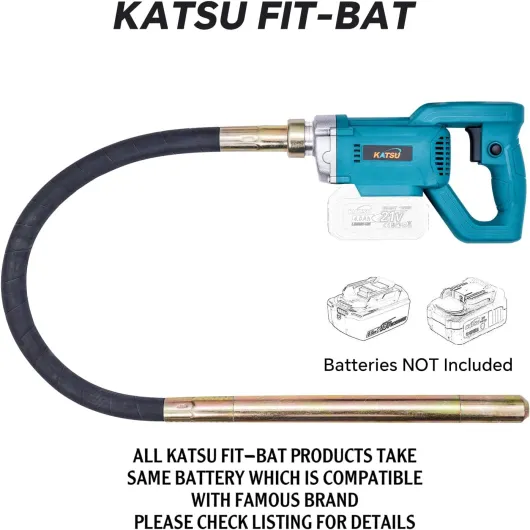
Design-wise, the KATSU concrete vibrator is pretty straightforward: a pistol-grip style handle, trigger, lock-on button, and a long nose where the flexible shaft connects. The body is mostly plastic with a cast aluminium gear housing at the front. You can feel it’s not a premium brand tool when you grab it – the plastic feels a bit cheap, and you get that light, hollow sensation compared to heavier-duty gear. But the shape is actually decent in the hand, and the balance with a 5Ah battery is okay.
The handle is reasonably ergonomic. I used it for multiple short bursts over a few hours, and my hand didn’t cramp up from the grip itself; the fatigue came more from holding the hose in position in the concrete. The lock-on switch is especially handy: you can keep the motor running without holding the trigger the whole time, which is important when you’re trying to control the poker head with your other hand. The switch feels a little cheap but functionally it worked every time for me.
One thing I noticed is the air outlets and cooling have clearly been thought about. The venting is placed so hot air doesn’t blow straight into your wrist, and even after longer runs the housing got warm but not crazy hot. The brushless motor helps here too – less heat and smoother running. Noise-wise, it’s obviously loud when the poker is running in air, but once you’re in the concrete it’s more of a steady buzz than a scream. Still not what I’d call quiet, but better than a petrol engine roaring next to your ear.
The main design downside for me is the overall robustness. On a big commercial site with heavy-handed use, I can see this plastic shell getting cracked or battered faster than more expensive brands. For DIY and lighter trade work, it’s acceptable, but I’d be more careful throwing it around in the van. So design is functional and thought-through enough, but you always feel it’s a budget build rather than a long-term site warrior.
Battery compatibility and runtime: good, but the fit is annoying
The big selling point with this tool is that it runs on 18–21V Makita-style batteries. I tested it with genuine Makita 5Ah and 6Ah packs I already use for other tools. Compatibility-wise, it’s fine: the batteries power it without any error or weird behaviour. The brushless motor helps squeeze more runtime out, and that’s noticeable. On one day, I vibrated around 2.5m³ of concrete with a single 6Ah battery, and it still wasn’t fully drained, which is pretty decent.
The downside is the actual physical fit of the batteries. This is where you feel the difference between an original Makita tool and a compatible one. Sliding the battery on sometimes takes a bit of force, and getting it off can be awkward, especially if your gloves are wet or muddy. It’s not impossible, just irritating when you’re tired and everything is covered in cement splashes. A couple of times I had to really yank the pack to get it off, which doesn’t inspire loads of confidence long term.
Runtime itself is good for what it is. For DIY users doing occasional pours, a single 4–5Ah battery is probably enough for a typical job like a patio slab, shed base, or a set of steps. For small builders, I’d say have at least two batteries ready, so you can swap if you get stuck into a longer pour. Because it’s brushless, the motor doesn’t bog down as quickly when the battery gets low; it tends to just stop rather than slowly dying, which is better for the motor but means you need to pay attention to battery level.
In short: if you already own Makita-compatible batteries, the battery side of this tool makes a lot of sense and keeps the cost down. If you don’t, you need to add the price of at least one decent 5Ah pack and a charger, which changes the value equation a bit. The only real gripe is that tight, slightly clumsy fit. It works, but it’s not smooth, and that’s a daily reminder you’re using a budget body with decent cells.
Build quality and durability: fine for light trade, not a site tank
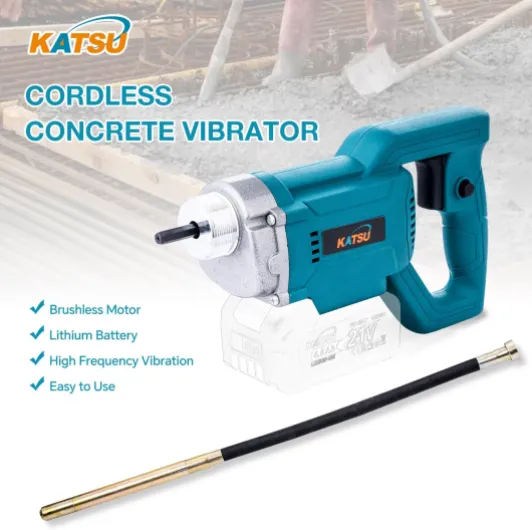
Durability is where you really feel the compromises. The KATSU vibrator has a cast aluminium gear housing at the front, which is a good sign, but most of the rest is plastic. After several uses, mine is holding up fine – no cracks, no weird noises, and the motor still spins smoothly. The hose and 35mm head also look okay, with no kinks or damage. The galvanized steel end feels solid enough for normal use, and I haven’t seen any obvious wear on the connection threads yet.
That said, compared to heavier-duty tools, it doesn’t feel like something you’d happily throw around on a rough commercial site day after day. The plastic body will probably be the weak point if it gets dropped from height or crushed under other tools in the van. The hose connection being a bit fiddly also means if someone cross-threads it or doesn’t tighten it properly, you could end up with damage at that joint sooner than you’d like.
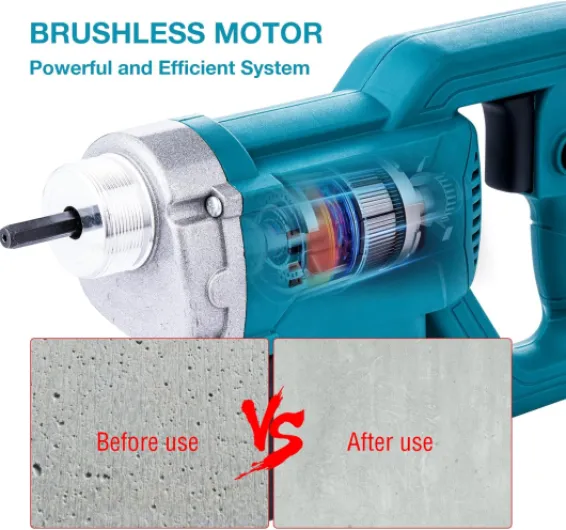
The brushless motor is a plus from a durability point of view. There are no brushes to wear out, and it runs cooler, which usually means longer life. I haven’t had it long enough to talk about years of use, but from experience, brushless tools tend to last better if the rest of the build holds up. The vents and cooling seem sensibly designed, and even on longer runs the motor housing only got warm, not roasting hot, which is reassuring.
Overall, I’d rate durability as “good enough for DIY and light trade if you treat it with a bit of care.” I wouldn’t expect it to survive the same abuse as a top-brand site tool, but for occasional pours, small jobs, and as a backup poker, it should be fine. Just don’t expect it to be indestructible, and try not to let the clumsiest guy on site be the only one handling it.
Performance in real concrete: strong enough, just slower than petrol
Let’s talk about what matters: how it actually performs in concrete. The spec says around 3200–3500 rpm with a 35mm head and a 1.2m shaft. In practice, the vibration is strong enough to do real work. On a 700mm thick slab I poured, it managed to pull out most of the honeycombing. I did notice I had to hold it in each spot a bit longer than I would with a petrol poker, but the end result was still decent consolidation and a much nicer finish than just rodding or tapping the formwork.
On smaller jobs like upstands and footings, it’s honestly more convenient than firing up a petrol unit. You just slot in the battery, screw on the hose, and go. I also liked the simple trick a reviewer mentioned: pull the trigger and tap the vibrating end on something solid to get it fully going before dropping it into the concrete. Once it’s running properly, you can see the surface of the concrete settle and air bubbles rise pretty quickly, which is exactly what you want.
Where you start to feel the limits is on larger continuous pours. If you’re trying to keep up with a big gang laying many cubic metres in one go, this tool will feel a bit underpowered and slow. You can still use it, but you’ll be spending more time in each spot, and you might struggle to keep pace with the pour. For my 2.5m³ day with a 6Ah battery, it coped, but I wouldn’t want this as my only poker on a major slab or big wall pour.
Overall, performance is in the “pretty solid for the price” category. It consolidates concrete properly, reduces honeycombing, and removes trapped air as advertised. You just have to be realistic: it’s geared more towards DIYers, small builders, and as a backup or secondary poker, not as the main weapon on a heavy commercial job. Used within those limits, it does what you need.
What you actually get (and what you don’t)
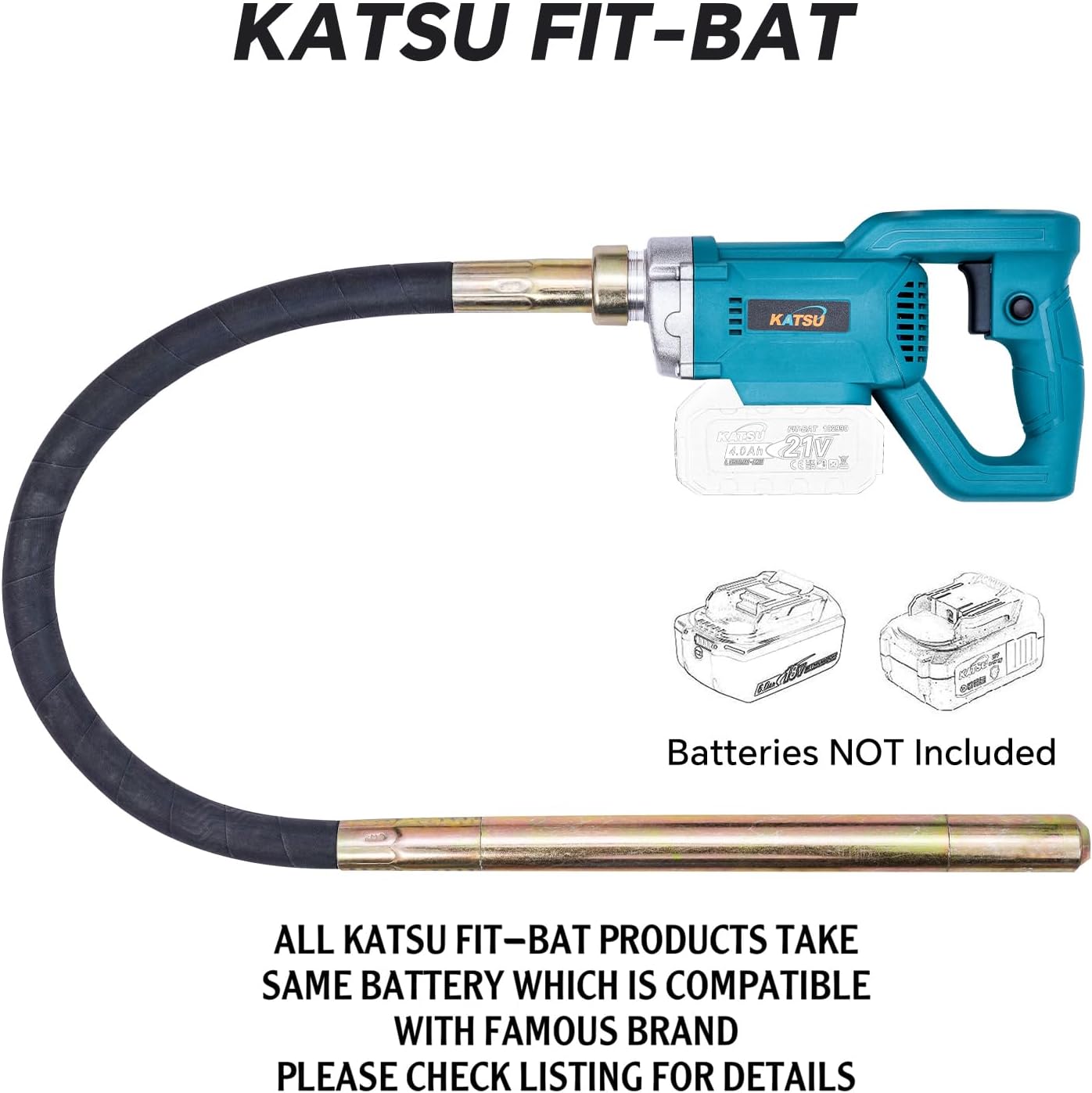
Out of the box, the KATSU FIT-BAT 21V is very straightforward: you get the main body, the 1.2m hose with a 35mm galvanized steel vibrating head, and that’s pretty much it. No battery, no charger, no fancy case. Mine came in a long cardboard box with moulded foam, which is basic but at least keeps everything in place for storage. It’s clearly aimed at people who already have compatible batteries (Makita LXT-style) and don’t need the full kit.
The first thing I did was check the hose connection and the battery slot. The hose screws on anti-clockwise when you’re looking at the drive shaft end, which is a bit counter-intuitive the first time. Once you know it, it’s fine, but it’s easy to think you’re tightening when you’re actually loosening. The connection does feel slightly fiddly, and if you don’t tighten it properly, it can start to work loose during use, which is annoying when you’re up to your ankles in concrete.
On the battery side, it’s advertised as compatible with Makita BL18xx and other LXT-style packs, and that’s accurate. My genuine Makita batteries slot in and run it without any hacking. That said, the fit isn’t as smooth as on a real Makita tool. You sometimes have to give it a firm push to get the battery to lock, and taking it off can need two hands. It’s not a deal-breaker, but it doesn’t have that clean, clicky feel of a premium tool.
So in terms of what you get: it’s a bare, functional kit with no frills. If you’re expecting a full setup with battery and charger, this isn’t it. But if you already live in the Makita ecosystem or you’re happy to buy a cheap compatible battery off Amazon, the package makes sense. Just don’t be surprised by the slightly rough edges on the fittings and the no-nonsense packaging. It looks and feels like a tool built to hit a price point, not to impress on the shelf.
Pros
- Good consolidation performance for small to medium pours
- Compatible with Makita-style 18–21V batteries and has solid runtime with 5–6Ah packs
- Much easier to handle than a petrol poker for upstands, small slabs, and footings
Cons
- Battery fit is tight and awkward compared to genuine brand tools
- Plastic body and hose connection feel less robust for heavy commercial site abuse
- Not ideal for large continuous pours where more power and speed are needed
Conclusion
Editor's rating
After using the KATSU FIT-BAT 21V cordless concrete vibrator on a few real jobs, my overall opinion is that it’s a practical, budget-friendly tool with some rough edges. It vibrates concrete properly, helps get rid of honeycombing, and is far more convenient than dragging out a petrol poker or hiring gear for every small pour. The brushless motor and Makita-compatible batteries are real positives, giving decent runtime and enough power for slabs, footings, and small structural pours.
On the downside, the build quality is clearly not at the same level as premium brands. The plastic body feels a bit cheap, the battery fit is tight and awkward, and the hose connection needs to be watched so it doesn’t work loose. For DIYers and small builders who look after their tools, these are annoyances rather than deal-breakers. For rough site use and big, continuous pours, I’d treat this more as a backup or a secondary unit rather than the main poker.
If you already own compatible batteries and you regularly pour small to medium volumes of concrete, this is good value and gets the job done without much fuss. If you expect it to replace a petrol poker on large commercial work, or if you don’t have any batteries yet, I’d think twice and maybe look at heavier-duty options. In short: decent cordless poker for light to moderate use, with some compromises that match the price.