Summary
Editor's rating
Value for money: decent little workhorse if your expectations are realistic
Compact block design that’s more about function than looks
Power and remote control: DC-only, no battery, but easy to integrate
Aluminium housing feels solid, electronics feel more budget
Early signs on durability: motor feels reliable, accessories less so
How hard it actually shakes and what it can realistically handle
What you actually get in the box (and what you don’t)
Pros
- Compact 30W brushless motor with solid aluminium housing and IP65 sealing
- 9-speed adjustment plus remote control make it easy to tune vibration from a distance
- Runs on simple 12V DC, easy to power from common supplies or batteries
Cons
- Controller and remote feel cheap and not very rugged for harsh environments
- Minimal documentation and generic branding, limited sense of long-term support

Specifications
View full product page →| Brand | Generic |
A small industrial vibrator you can control with a TV-style remote
I’ve been using this brushless vibration motor with the remote controller on a small grain cleaning setup and a DIY screener for about two weeks. It’s from a generic brand, so I went in expecting something basic, not a high-end industrial unit. The main reason I bought it was the combo of 12V power, compact size, and remote speed control. I wanted something I could run off a small DC power supply and move between machines without rewiring everything.
First impression: it’s heavier and more solid than it looks in the photos. For such a small block, 0.95 kg is no joke. When you bolt it down properly and crank it up, it actually shakes light frames quite a bit. It’s only 30W, so don’t expect it to move a concrete bunker, but for small hoppers, small chutes, or test rigs, it does the job. The included controller and remote are what make it interesting; without those, it would just be another small vibrator motor.
In day-to-day use, I mainly tested it on a homemade sieve table (about 60 x 40 cm) and on a small funnel that tended to clog. On the sieve, speeds 5–9 were usable, below that the movement was too soft to really move material. On the funnel, lower speeds were enough just to keep things from sticking. The 9-speed adjustment sounds fancy, but in reality, you’ll probably only use 3–4 of those steps depending on the job.
Overall, my first takeaway is: it’s a compact, functional little vibrator that makes sense for light-duty or experimental setups. It’s not perfect: generic documentation, no clear brand support, and the remote feels cheap. But if you know what you’re doing and you just need a 12V vibration source with adjustable speed, it’s pretty decent. If you expect full industrial support and plug-and-play integration into a factory line, you’ll probably be annoyed by the generic side of it.
Value for money: decent little workhorse if your expectations are realistic
Price-wise, this sits in that mid-low range for small vibration motors with a controller. You’re clearly not paying premium-brand money, but you are getting a brushless motor, IP65 housing, 9-speed control, and a remote. That combination is not bad at all if you actually need the remote functionality. If you only need a fixed-speed vibrator, you can probably find cheaper units without the controller and remote that will do the same basic job.
For me, the value comes from the flexibility: I can move it between a hopper, a sieve, and a small mold-vibration setup without rewiring or changing drives. I just bolt it down, hook up 12V, and adjust speed with the controller or remote. For small DIY industrial projects, lab setups, or prototyping, that’s very handy. I don’t have to invest in a full inverter or a big 3-phase motor just to test something.
On the downside, you do feel the generic-brand compromises: minimal documentation, no clear support channel, and accessories that feel a bit cheap. If something fails in a year, you might be replacing the whole unit rather than getting spare parts. Also, the claimed application list (mining, metallurgy, coal, etc.) is a bit optimistic in my opinion. For large-scale heavy industry, I’d go with a known industrial brand, even if the price is higher, because downtime costs more than the motor.
Overall, I’d say it’s good value for light-duty industrial or serious DIY use, as long as you go in knowing what it is: a compact 30W vibrator with nice features but generic branding. If you’re budget-conscious and technically comfortable enough to sort out small issues yourself, it’s a reasonable buy. If you want rock-solid support, branded documentation, and very rugged accessories, this will feel a bit cheap, and you might be better off spending more upfront.
Compact block design that’s more about function than looks
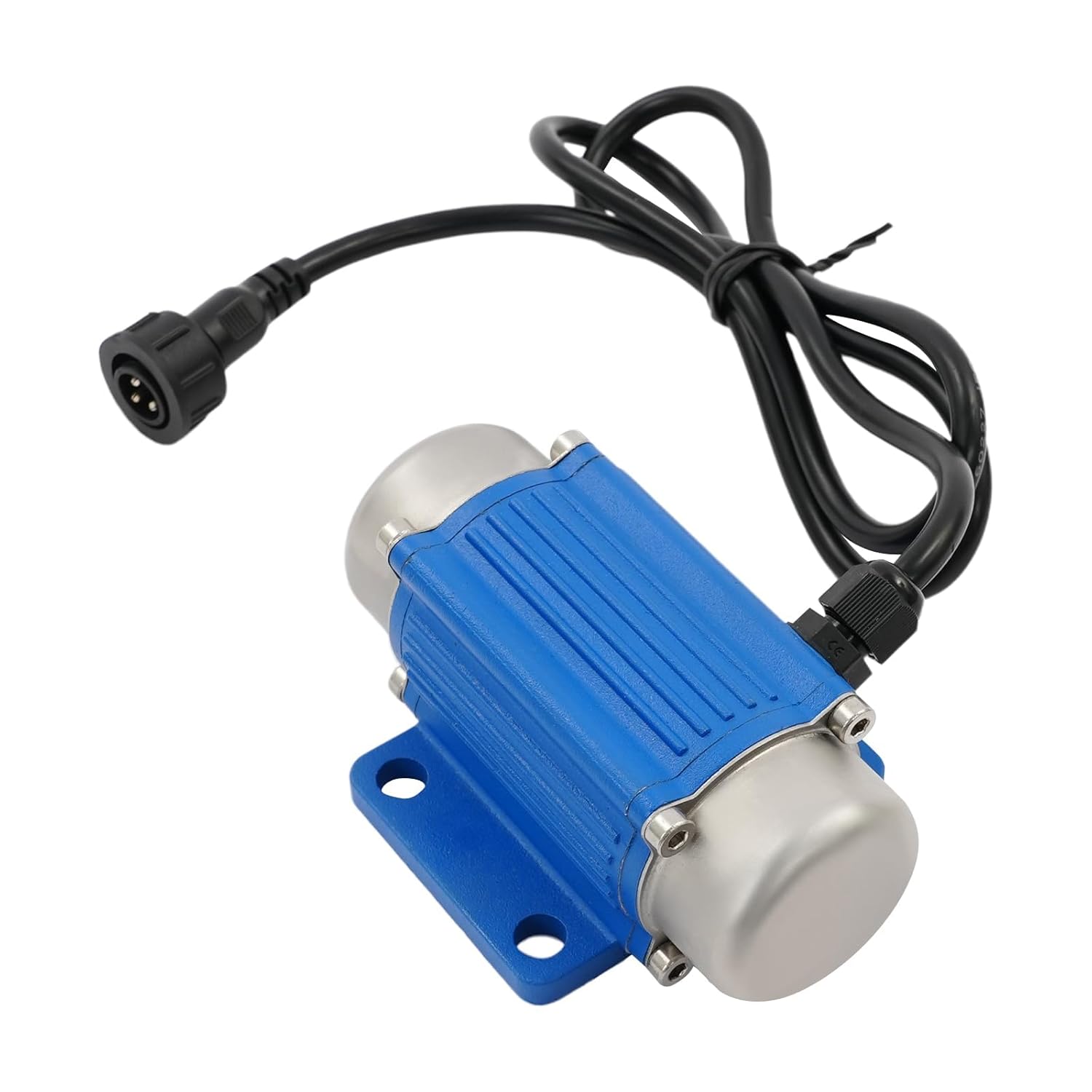
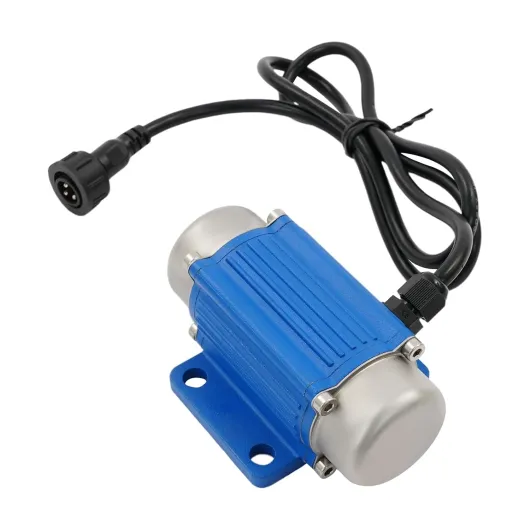
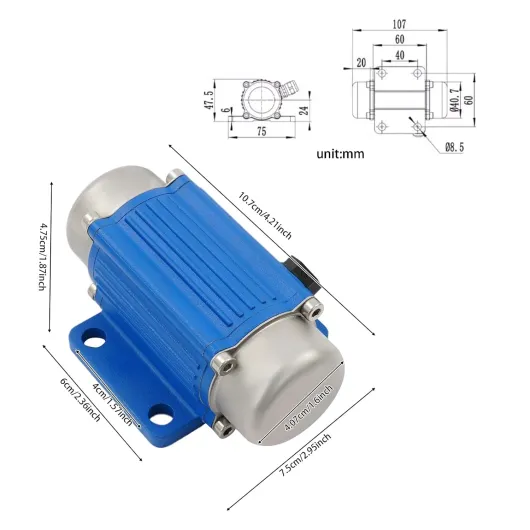
The design is very straightforward: a compact rectangular motor body (about 105 x 75 x 47 mm) with rounded corners and two blue end caps. The casing has pre-drilled mounting ears on the sides, so you can bolt it down either horizontally or vertically depending on your frame. The rounded corners are not just for looks; you actually notice it when you’re handling it in tight spaces since you’re less likely to scratch yourself or catch on a sharp edge.
On the controller side, it’s a small plastic box with a few buttons and indicator lights. Nothing fancy, but it’s clear enough: up/down for speed, a power button, and a simple display or LED indicators for the speed level. The 9-speed steps are easy to see and change. I like that they kept it simple and didn’t overcomplicate the UI, but at the same time, the controller doesn’t feel especially rugged. For a dusty or dirty environment, I’d probably mount it in a protected spot or even put it inside a small enclosure.
The remote control is basic, almost like a cheap TV remote. Lightweight plastic, simple buttons. It does the job, but it doesn’t inspire much confidence if you’re planning to use it daily in a workshop or on a construction site. I tested the remote distance in an open area: around 20–25 meters was reliable, which is close to the claimed 30 m, but once there were metal structures in between, the range dropped. So the advertised distance is realistic only in ideal conditions.
Overall, the design is functional and compact. It’s clearly built with industrial use in mind, but more for light-duty or auxiliary tasks than for the heart of a big production line. It’s not pretty, and the plastics on the controller and remote feel a bit cheap, but the motor body itself looks thought-out: rounded edges, mounting options, and a compact footprint that’s easy to integrate into small machines or test rigs. If you care more about how it works than how it looks, you’ll be fine with it.
Power and remote control: DC-only, no battery, but easy to integrate
Just to be clear: there is no built-in battery in this thing. It runs purely on DC 12V and pulls up to about 2A according to the specs. I tested it with a bench power supply and a 12V 10A switch-mode PSU, and it behaved as expected. If you want to use it in the field away from mains, you could easily pair it with a 12V battery (like a car battery or a deep-cycle battery) and a simple fuse. At 30W, even a modest battery will give you a decent runtime, but of course, that depends on how hard and how long you run it.
The interesting part is the remote control distance. The spec says 30 m, and in an open workshop with line-of-sight, I got reliable control out to about 20–25 m. Beyond that, it still worked sometimes, but it was hit or miss if I didn’t point it well. As soon as you put metal structures, walls, or big machines in between, the range drops. So, the 30 m is more of a best-case scenario. For typical use (standing a few meters away or on the opposite side of a small machine), it’s perfectly fine.
In practical terms, having the speed controller powered by the same 12V line makes integration pretty simple. You just bring one 12V feed to the controller, then the controller feeds the motor. No separate power for the remote or anything weird. The remote itself uses a standard button cell (mine came pre-installed), so there’s nothing complicated there either. After two weeks of use, the remote battery is still fine, but it’s not like I was pressing it all day long.
So, under the “battery/power” topic, the situation is: no onboard battery, but very easy to power from common 12V sources, and the remote is handy enough if you stay within a normal distance and line-of-sight. If you were hoping for a completely wireless vibrator with integrated battery, this is not it. If you’re okay running a 12V line and just want wireless control for convenience and safety (not having to lean over a running machine), it does the job.
Aluminium housing feels solid, electronics feel more budget
The motor housing is aluminium alloy with a baked paint finish, and that part honestly feels pretty solid. When you tap it or clamp it down, you get that dense, rigid feel you want from a vibration motor. The manufacturer mentions die casting and copper internals, and from what I can see and hear, that lines up: the rotor spin is smooth, and there’s no weird rattling or cheap bearing noise so far. They also claim pure copper coils, which I obviously can’t confirm without tearing it apart, but current draw and heat levels seem normal for a 30W brushless motor.
The IP65 rating and the sealing design are also a big plus on paper. There are visible sealing grooves and gaskets where the covers meet the housing. I didn’t dunk it in water, but I did run it in a pretty dusty environment (grain dust, fine particles) and wiped it down with a damp rag a few times. No sign of dust ingress or issues. For normal workshop or small industrial use, it seems more than adequate. I wouldn’t leave it outside in heavy rain all year, but for indoor or semi-sheltered setups, the sealing feels trustworthy.
Where you feel the cost savings is in the controller and remote. The controller box is thin plastic with basic buttons. It doesn’t feel like it would survive a hard drop on concrete or getting crushed under a tool chest. The remote is even more basic, very lightweight plastic, and I’d be surprised if it handled rough handling for long. That said, both have been working fine for my tests; they just don’t give that tough industrial vibe you might expect when you read "for mining, metallurgy, coal" in the description.
So in terms of materials: motor body and internals feel decent for the price, electronics and plastics are clearly budget but functional. If you plan to use it on a fixed installation where the controller is protected and the remote doesn’t get abused, it’s acceptable. If your environment is very harsh (heavy impacts, a lot of chemical exposure), I’d be careful and maybe look at more established brands with tougher housings, even if it costs more.
Early signs on durability: motor feels reliable, accessories less so
I’ve only had this motor for a couple of weeks, so I can’t pretend I’ve tested it for years. But I did run it in a few different conditions: continuous runs of 30–60 minutes, repeated starts and stops, and a fair bit of dust around. The motor itself hasn’t shown any weird behavior: no increase in noise, no wobble, no random shutdowns. The bearings still feel smooth, and there’s no visible play when I try to wiggle the shaft area. For a generic-brand motor, that’s reassuring.
The IP65 rating seems to hold up in normal workshop conditions. I got it lightly splashed during cleaning and covered in grain dust more than once. I wiped it down, checked the seals, and everything looked fine. I wouldn’t pressure-wash it or leave it soaking, but for daily use around dust and occasional splashes, it seems built for that. The aluminium housing also doesn’t show any signs of cheap paint flaking off yet, even after being clamped and unclamped a few times.
Where I’m less confident long-term is the controller and remote. The controller box flexes a bit if you press it hard, and the buttons don’t feel like they’re meant for years of abuse with greasy gloves. The remote is the weakest link in terms of feel; it works, but it just feels like a low-cost generic remote. I’ve already decided I’ll probably mount the controller in a small protective box if I keep using this setup regularly, just to avoid dust and accidental hits.
So my early verdict on durability: motor: promising; accessories: okay but treat them gently. If you install the motor properly (tight bolts, flat surface, maybe rubber pads if needed) and protect the electronics from impacts and heavy dust, I don’t see any immediate red flags. But if you expect something you can throw around a construction site with zero care, I’d go for a more robust brand, even if it costs more. This feels more suited to small fixed installations and test benches than hardcore rough environments.
How hard it actually shakes and what it can realistically handle
On paper, this thing is a 30W brushless motor with a maximum speed of 7000 rpm and an excitation force of 0.2 kN. In real life, that translates to a decent amount of vibration for small to medium-sized structures, but don’t expect it to drive a big concrete screed or a massive vibrating feeder. I mounted it on a small sieve table first. At speeds 7–9, it gave enough amplitude to move grain and small gravel across the screen without stalling. The vibration is quite high-frequency and relatively tight, not a big slow shake.
The 9 speed levels are actually useful. You can clearly feel the difference between, say, level 3 and level 8. For a sticky hopper, I found that levels 4–6 were enough to keep material flowing without making the whole frame buzz too violently. For the sieve table, I mostly used 7–9. The motor starts up smoothly; there’s no brutal jerk, which is nice if your frame isn’t super heavy. Noise-wise, it’s not silent, but the sound is mostly a high-pitched whirr and the structural vibration noise from whatever it’s bolted to. On its own, the motor is not that loud; it’s the attached metal that amplifies everything.
I also checked current draw with a meter. At higher speeds under load, it stayed close to the 2A spec at 12V, sometimes a bit under. Heat was reasonable: after about 30–40 minutes of continuous use at high speed on the sieve, the housing was warm to the touch but not alarming. The insulation class F and the -20°C to 40°C ambient range seem realistic for normal workshop conditions. I wouldn’t run it at max speed 24/7 in a hot, unventilated box, but for intermittent or medium-duty use, it behaved well.
Overall, performance is solid for its size and power. It’s clearly intended for small machinery:
- Keeping product flowing in small hoppers or chutes
- Driving compact screens or test rigs
- Helping with material settling in small molds or containers
What you actually get in the box (and what you don’t)
When the package showed up, it was a plain cardboard box, no real branding, just a basic label with the model and specs. Inside, the motor and controller were wrapped in foam. Protection was fine; nothing arrived damaged. But don’t expect a nice manual or branded packaging. You get a very short leaflet with wiring diagrams that are just enough if you already know how to handle DC power and polarity. If you’re a beginner with electrics, you’ll probably have to double-check things online.
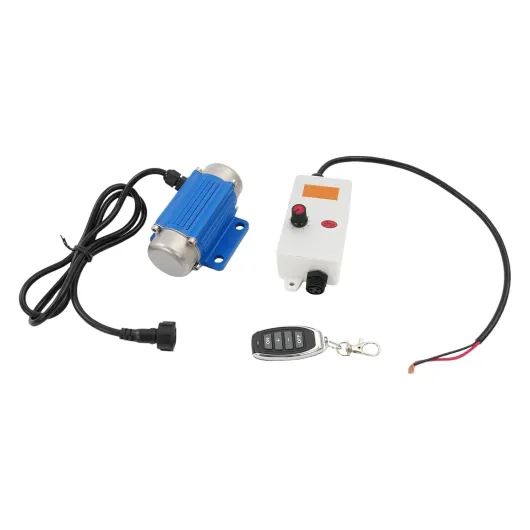
The kit I received included:
- The brushless vibration motor itself (silver body with blue covers)
- A separate speed controller box with buttons and a small display
- A basic IR remote with speed up/down and on/off
- A short wiring diagram sheet, nothing more
In practice, setup took me about 20–30 minutes the first time, mostly because I double-checked the wiring and polarity. The motor and controller both have pre-drilled holes, so fixing them to a plate or frame is simple if you have M4/M5 bolts lying around. But again, nothing is labeled like a well-known brand product; it’s functional but a bit generic. You need to be comfortable with the idea that support is basically whatever you figure out yourself.
So in terms of presentation, it’s very no-frills. You get the essential hardware, that’s it. No fancy branding, no detailed user guide, no accessories. If you want plug-and-play guidance, you’ll be disappointed. If you just care that the motor, controller, and remote are there and intact, it’s fine. Personally, I would have liked at least some clearer specs on paper (like recommended duty cycle, mounting tips, etc.), but for the price range, I kind of expected this barebones approach.
Pros
- Compact 30W brushless motor with solid aluminium housing and IP65 sealing
- 9-speed adjustment plus remote control make it easy to tune vibration from a distance
- Runs on simple 12V DC, easy to power from common supplies or batteries
Cons
- Controller and remote feel cheap and not very rugged for harsh environments
- Minimal documentation and generic branding, limited sense of long-term support
Conclusion
Editor's rating
After a couple of weeks using this brushless vibration motor on a small sieve table and a hopper, my opinion is pretty straightforward: for its size and price, it gets the job done. The motor body is compact, feels solid, and the vibration level is more than enough for small machinery, test setups, or DIY industrial projects. The 9-speed adjustment and the remote control are genuinely useful, not just a gimmick, especially when you want to tweak vibration without leaning over a running machine.
It’s not perfect though. The controller and remote feel budget, and the documentation is bare minimum. This is clearly a generic product: no big brand name, no fancy manual, and probably limited support if something goes wrong. I wouldn’t personally put it at the center of a high-stakes production line, but for side equipment, lab gear, or smaller one-off machines, it makes sense. If you’re comfortable wiring 12V DC, bolting things down properly, and maybe protecting the controller yourself, it’s a practical little tool.
So, who is it for? People who need a compact 12V vibrator with adjustable speed, work mostly on small setups, and don’t mind a generic brand. Who should skip it? Anyone who needs heavy-duty industrial reliability, strong after-sales support, or ultra-rugged electronics. In short: decent little workhorse for light-duty tasks, as long as your expectations match the price and the generic nature of the product.