Summary
Editor's rating
Value for money: worth it if you already have Dewalt batteries
Chunky, simple design with a few quirks
Battery use: fine if you already own Dewalt packs
Packaging and extras: just the basics
Build quality and how sturdy it feels
How it actually performs on real tiling jobs
What you actually get out of the box
Pros
- Works with existing Dewalt 20V batteries, no extra chargers needed if you’re in that ecosystem
- Strong enough vibration with 6 adjustable gears to handle medium and large tiles
- Cordless design avoids cable hassles and makes it easier to work in tight bathrooms or around fresh adhesive
Cons
- No battery or charger included, poor value if you don’t already own Dewalt packs
- Build quality and packaging feel budget and not really aimed at heavy professional use
- Suction performance depends a lot on surface cleanliness; the 200 kg claim is optimistic in practice

Specifications
View full product page →| Brand | Roadtime |
A cordless tile vibrator that plugs into your Dewalt life
I’ve been doing small tiling jobs on and off for a few years: bathrooms, kitchen splashbacks, a couple of patios. Until now I did everything the old way: rubber mallet, patience, and a sore wrist at the end of the day. I picked up this cordless tile vibrator mainly because it works with Dewalt 20V batteries, and I already have a few of those lying around from my drill and impact driver. I didn’t expect a miracle, I just wanted something to help bed larger tiles without beating them to death.
First impression: it’s a no-name brand tool with specs that look a bit optimistic on paper (200 kg suction, up to 18,000 rpm, tiles up to 260 cm). I used it for a bathroom wall with 60×60 tiles and a small hallway floor with 80×80 tiles over two weekends. So not a huge construction site, but enough to see if it’s helpful or just another gadget that will end up in the back of the shed.
In use, the main thing I noticed is that it really does save your hands and wrists. Instead of tapping every corner and center of each tile, you stick this thing on, hit the trigger, and let it do the boring part. It doesn’t magically fix bad leveling or a wavy screed, but it helps settle the tile into the adhesive and get rid of some air pockets. For bigger tiles, that’s already a nice win.
It’s not perfect though. The build feels more “budget” than pro, the digital display is more of a gimmick than a real need, and the claimed 200 kg suction is optimistic in real life, especially on dusty backs or slightly textured tiles. But overall, for a DIYer who already owns Dewalt batteries, it’s a pretty solid helper that makes tiling less tiring and a bit faster, as long as you know it’s not a magic wand.
Value for money: worth it if you already have Dewalt batteries
On the value side, the key point is that this tool makes sense mainly for people who already have Dewalt 20V batteries. In that case, you’re paying just for the bare machine, and for the price range it sits in, it’s actually pretty decent. You get a cordless tile vibrator with adjustable speed, a big suction cup, and enough power to handle typical DIY tiling jobs. Compared to buying a full pro kit from a known tile brand, this is noticeably cheaper, even if the finish and long-term durability are not at the same level.
If you don’t own any Dewalt batteries, I’d think twice. Once you add the cost of a genuine battery and charger, the overall investment jumps, and at that point you might prefer to look at other options, maybe even corded models that come complete out of the box. A corded vibrator will be less convenient, but if you’re only doing one renovation project, it may make more financial sense than building a whole battery ecosystem around a single tool.
In terms of what you actually gain for the money: it saves time and reduces fatigue. For me, the main value is less strain on the wrists and more consistent bedding of large tiles. On my bathroom and hallway job, I felt fresher at the end of the day, and I was less stressed about missing hollow spots. That’s not something you can easily put a number on, but if you’ve done a lot of tiling with a mallet, you’ll feel the difference.
So overall, I’d rate the value as good but not mind-blowing. It’s not dirt cheap, but it’s not overpriced either considering the functionality. There are better, more refined tools on the market, but they also cost more. This one sits in a kind of sweet spot for serious DIYers or small-scale renovators who already live in the Dewalt world and want a practical helper without spending pro-tool money.
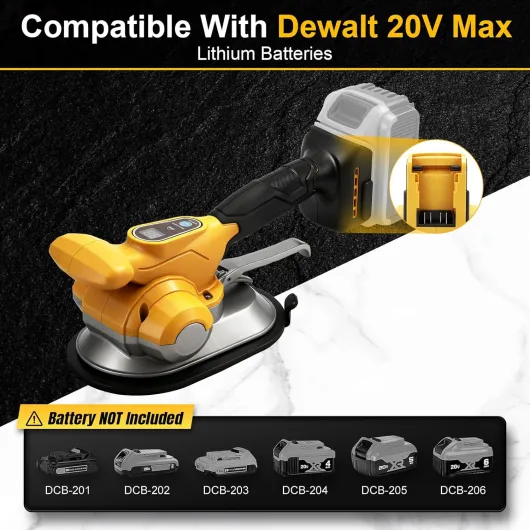
Chunky, simple design with a few quirks
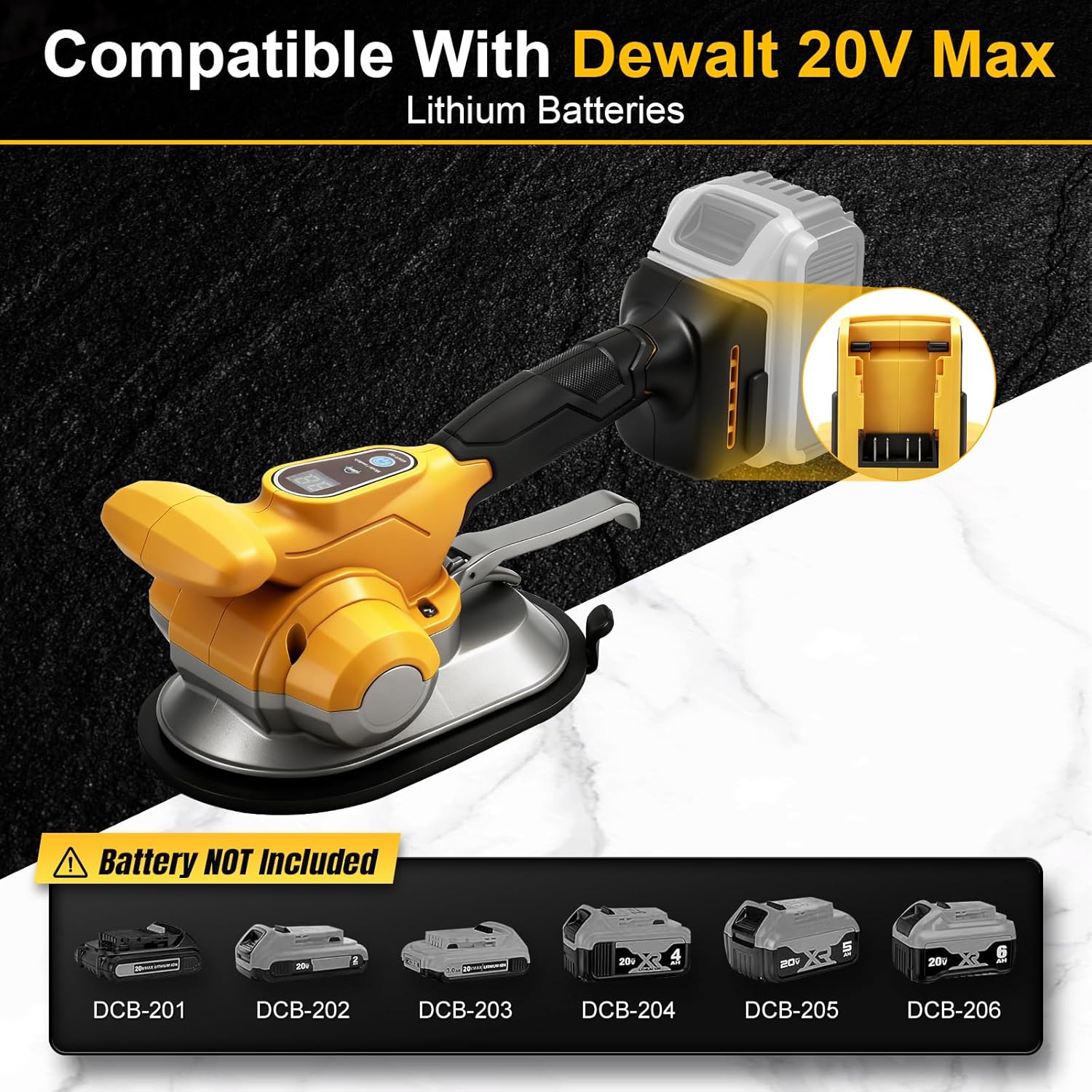
Design-wise, it’s a pretty typical Chinese OEM tile vibrator: a plastic and aluminium body, a big 20 cm black suction cup at the front, and a handle at the back where you slide in the Dewalt 20V battery. The layout is fairly logical: trigger under the handle, buttons and display on top where you can see them, and the bubble level also on top. The shape is a bit bulky but manageable; I didn’t feel like it was awkward to hold, even when working on walls at shoulder height.
The weight with a 5 Ah Dewalt battery ends up around 2 kg or a bit more by feel. For short bursts per tile, that’s fine. If you’re doing a whole wall of large tiles, your arm will feel it, but it’s still less tiring than hammering every tile by hand. The center of gravity is slightly biased towards the battery side, so you naturally hold it more towards the rear. With the suction cup engaged, that bias actually helps press the tile in, but you need to make sure you’re not pulling the tile out of alignment when you lift the tool off.
I liked the fact that the controls are simple: a big on/off, plus and minus for speed, and the trigger. You don’t get lost in menus or modes. The digital display is readable enough indoors, but in very bright light, like near a window or outdoors, it becomes harder to see. Not a deal breaker, but don’t buy it for the screen. The bubble level is small but visible; I used it mainly to check that I wasn’t massively off when placing a tile, not as my main reference.
One thing to note: the suction cup is quite large, which is good for grip but a bit annoying on narrow tiles or near edges. On a 30 cm wide tile, you need to be careful not to go too close to the edges, otherwise you lose suction. Also, the edges of the suction cup are quite stiff when new; after a few uses they soften a bit and seal better. Overall, the design feels thought through enough for DIY use, but it’s not as refined as more expensive pro tools. It gets the job done without trying to be fancy.
Battery use: fine if you already own Dewalt packs
This tool doesn’t come with a battery or charger, which is clearly stated, but still easy to overlook if you skim product pages. I ran it with two Dewalt 20V batteries I already had: a 4 Ah and a 5 Ah. With the 5 Ah pack, I managed to do around 3–4 hours of intermittent tiling (so actual vibration time is much lower, of course) across a weekend without fully draining it. Roughly, I’d say if you’re actively using it a lot on mid to high gears, you’ll want at least one 4 Ah battery to be comfortable for a half-day session.
The power draw feels moderate. The motor is rated at 550 W, but in practice you’re pulsing it: a few seconds per tile, then move, adjust, etc. The cordless part is genuinely useful. Not having a cable dragging over fresh adhesive or knocking your tile spacers out of place is a big plus. I’ve used corded vibrators before, and the cable is always in the way, especially in tight bathrooms. Here, you just grab it, slap it on the tile, and go.
Battery fit was good with my genuine Dewalt batteries; no wobble, no weird play. The latch clicks solidly. I didn’t test it with third-party batteries, but given how picky some tools are, I’d stick with originals or at least decent compatible packs. Heat-wise, the tool gets warm after repeated use, but not worrying. The battery itself stayed within a normal temperature range; nothing like when you push an impact driver hard.
If you don’t already own Dewalt 20V batteries, this whole product becomes less interesting, because by the time you buy a battery and charger, you might as well look at a full kit from a more established brand. But if you already have a couple of Dewalt packs in your toolbox, this tile vibrator plugs into your setup nicely and doesn’t cause any battery headaches. Just make sure you charge up before a big tiling session, because once it’s dead, you can’t just plug it into the wall as a backup.

Packaging and extras: just the basics
The packaging is very standard Amazon-level stuff. Cardboard box, some foam to hold the tool, a thin manual, and a simple cloth bag. Don’t expect a hard case, molded inserts, or any kind of professional storage system. The box arrived intact and the tool wasn’t damaged, so it did its job, but it’s clearly not meant to be reused as long-term storage unless you like keeping random boxes in your workshop.
The cloth bag is okay for keeping dust off the tool when it’s on a shelf, but that’s about it. It’s not padded and doesn’t have separate compartments for batteries or accessories. I ended up just tossing the machine into a larger tool bag with my tiling gear. If you’re moving between sites regularly, you’ll probably want to give it a bit more protection, maybe a small plastic case with some foam you cut yourself. For a DIYer who stores tools at home, the cloth bag is enough to keep it from getting grimy.
The manual is short and a bit generic, but at least it’s in understandable English. It covers the basics: how to attach the battery, how to turn it on, adjust speed, and a few safety notes. It doesn’t go into any depth about best practices for different tile sizes or adhesives, which would have been useful for beginners. If you’ve never used a tile vibrator before, you’ll probably end up watching a couple of videos online to get a feel for how long to vibrate each tile and where to place the cup.
Overall, the packaging and extras match the price and the generic brand: functional but nothing more. There’s no sense of a complete “kit” here, just the bare tool. If you like your tools nicely organized with custom cases and foam, you’ll be a bit disappointed. If you just want the machine and don’t care about the rest, it’s fine. Just be aware you’re not getting the polished experience you might get from a higher-end tiling system.
Build quality and how sturdy it feels
I’ve only used it over two medium jobs so far, so I can’t pretend I’ve stress-tested it for years. But based on a few solid days of use, I can say this: it feels like a mid-range, generic tool. Not junk, not pro-grade, somewhere in between. The shell is plastic with some aluminium parts around the motor area. There’s a bit of flex if you squeeze the housing hard, but nothing that screams “about to crack”. The buttons have a slightly cheap click, but they responded consistently and didn’t get stuck even with dusty fingers.
The suction cup rubber is thick and seems decent. After several dozen tiles, I didn’t see any cracks or cuts. I did make a habit of wiping it down after each session and not leaving it caked in dried adhesive, which helps. The mounting of the cup to the body feels solid; I didn’t notice any wobble or misalignment. If something is going to wear out first, I’d bet it will be the suction cup edge or the internal seals, not the motor itself.
The motor, advertised as pure copper, runs smoothly and didn’t show signs of overheating. After longer stretches on high gear, the front of the tool got warm, but not hot enough to worry. No burning smell, no weird noises. The vibration stayed consistent; there was no sudden loss of power or random shutoffs. The fact that it uses a known battery platform (Dewalt 20V) also gives a bit of confidence that the power electronics are at least somewhat compatible with those packs.
That said, I wouldn’t treat it like a site-grade tool. I wouldn’t leave it rolling around in the back of a van under other tools or let it fall from a ladder. The included cloth bag is more of a dust cover than real protection. If you’re a pro tiler working every day, I’d be cautious and maybe look at more recognized brands that are built for heavy abuse. For occasional DIY or light renovation jobs a few times a year, this looks sturdy enough if you don’t mistreat it. Time will tell, but nothing in my use so far rang alarm bells about immediate failure.
How it actually performs on real tiling jobs
In terms of pure performance, the main point is simple: it vibrates strongly enough to settle medium and large tiles into the adhesive, and it does it consistently. I used it on standard ceramic and porcelain tiles with flexible adhesive. On gear 3–4, it was already enough to see the tile sink a bit, squeeze out some excess glue at the edges, and make a slightly hollow spot sound more solid when tapped afterward. For thicker adhesive beds (like on a slightly uneven floor), I bumped it up to gear 5–6 to really work the tile down.
The 6 adjustable gears are useful. On small wall tiles or when you’re close to an edge, I kept it on a lower gear to avoid overdoing it and shifting the tile. On large floor tiles, I cranked it up and did 2–3 passes: center, then near the corners (but not right on the corner, to avoid cracking). The vibration feels fairly even, and the tool doesn’t jump around as long as the suction holds well. Noise-wise, it’s not quiet, but it’s not worse than a typical cordless drill. You can talk over it without shouting.
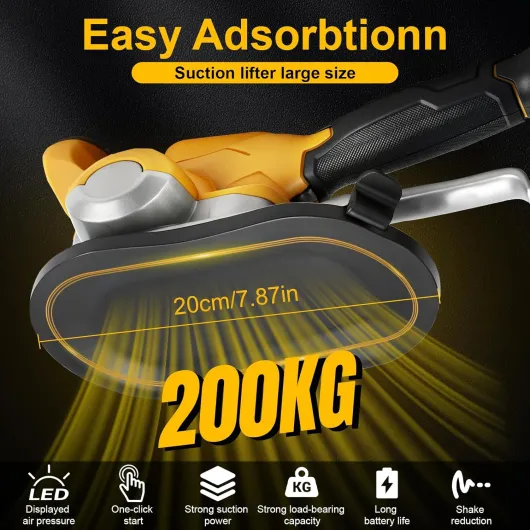
About the famous “200 kg adsorption”: in real conditions, you don’t get that. On a perfectly smooth, clean, glossy tile, suction is strong and the tool stays put nicely. On slightly dusty backs, lightly textured tiles, or if there’s a bit of adhesive smear, the grip is weaker and you can feel it wanting to slide a bit. Cleaning the cup and the tile surface helps a lot. I’d say the suction is good enough for safe use if you’re not trying to lift the tile by the machine alone like a crane. I used my other hand to support the tile whenever I moved it, which is the sensible way.
Compared to manual hammering, I’d say it improved my speed by maybe 20–30% on the bathroom wall and floor job, mainly because I wasn’t stopping to tap every tile so long. The bigger gain for me was consistency: the tiles sounded more evenly bedded, and I had fewer spots where I felt the need to rework a tile. It doesn’t fix bad prep work, but as a tool to speed up and standardize the bedding step, it does what it’s supposed to do pretty well for home and light renovation projects.
What you actually get out of the box
Out of the box, the package is pretty barebones: you get the cordless tile vibrator itself, a 20 cm suction cup already mounted, a small cloth bag, and that’s about it. No Dewalt battery, no charger, no extra pads or accessories. So you really need to already have a compatible Dewalt 20V battery (like DCB200–206). If you don’t, the tool suddenly becomes much less attractive because buying an original Dewalt battery just for this will cost more than the machine itself.
The tool is rated at 550 W, with 6 adjustable gears and a vibration frequency range from 3000 to 18,000 r/min. On the handle you have a power button, a +/- control to change the vibration speed, and a small digital display that shows the gear or speed level. There’s also a small bubble level on top to help with tile positioning. In practice, that bubble is only really useful when you’re holding the tool still on the tile; once it’s vibrating, you’re mostly relying on your tile clips or spirit level anyway.
The official specs say it can handle tiles from 30 to 260 cm. To be honest, I mainly used it on 60×60 and 80×80 tiles. I tried it on a small 30×60 wall tile and it was fine, but anything smaller than that feels a bit overkill. On the other end, I wouldn’t be super confident using this solo on a 2.4 m slab unless the tile is already well supported and you’re just using it to settle the adhesive. The 200 kg adsorption figure looks good on paper, but like most of these numbers, it assumes a perfectly clean, smooth surface.
Overall, the presentation is straightforward: it’s a simple cordless tool that leans on the Dewalt battery ecosystem and promises easier, faster tile bedding. No fancy case, no big instruction manual with tips, just the basics. If you’re used to generic tools from Amazon, it’s in the same league: functional, but don’t expect the same level of finish or accessories you’d get from a big brand like Rubi or Raimondi.
Pros
- Works with existing Dewalt 20V batteries, no extra chargers needed if you’re in that ecosystem
- Strong enough vibration with 6 adjustable gears to handle medium and large tiles
- Cordless design avoids cable hassles and makes it easier to work in tight bathrooms or around fresh adhesive
Cons
- No battery or charger included, poor value if you don’t already own Dewalt packs
- Build quality and packaging feel budget and not really aimed at heavy professional use
- Suction performance depends a lot on surface cleanliness; the 200 kg claim is optimistic in practice
Conclusion
Editor's rating
After using this cordless tile vibrator on a couple of real jobs, my overall feeling is that it’s a solid helper for DIY tiling, especially if you already own Dewalt 20V batteries. It vibrates strongly enough to bed medium and large tiles into adhesive, the 6 speed levels are actually useful, and the cordless design is a real plus when you’re working in tight spaces or around fresh adhesive. It doesn’t feel like a top-tier professional tool, but it does the core job well: fewer sore wrists, more consistent tiles, and slightly faster progress.
On the downside, the build quality is clearly in the "budget but acceptable" category, the digital display is more cosmetic than essential, and the claimed 200 kg suction is optimistic in real-life conditions. The packaging is minimal, and there’s no battery or charger, so the value drops a lot if you’re not already in the Dewalt ecosystem. I also wouldn’t rely on it as a daily workhorse on rough construction sites; it’s better suited to homeowners, handymen, or small renovation jobs rather than full-time pro tilers.
If you regularly lay medium to large tiles at home or as a side gig, already have Dewalt batteries, and want something to make the job less tiring and a bit more consistent, this tool is worth considering. If you’re only doing one small bathroom in your life or don’t own any Dewalt gear, I’d either rent a higher-end vibrator or stick with a mallet and spend the money elsewhere. It’s a good, practical tool within its niche, as long as you go in with realistic expectations.